

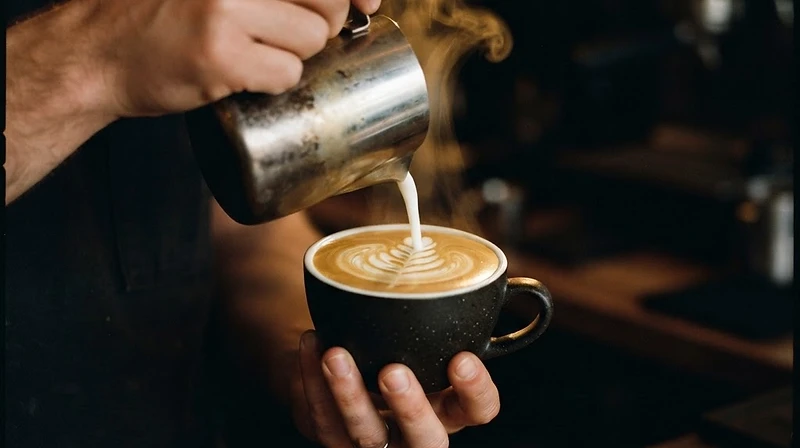
Espresso Art
A shot you can taste and a picture you can drink, drawn in ten seconds of poured milk.
But first, a little context and history...
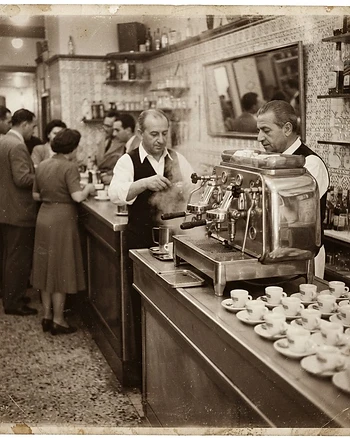
Espresso itself is an industrial story before it is an artistic one. The first machine built to force hot water through a compressed bed of coffee was patented in Italy in 1901, and for decades the drink was a fast, strong, workingman's pour served without ceremony. The change came after the Second World War, when a spring-loaded piston machine let a barista control the pressure by hand and, for the first time, produced a stable layer of foam on top of the coffee. That layer had a name, crema, and it turned the surface of a cup into something you could look at.
Milk met coffee long before that, of course. The cappuccino had been a café staple since the early twentieth century, and Italian baristas were already practiced at folding hot milk into espresso without destroying it. What they were not doing, at least not deliberately, was drawing. The milk was there for body and temperature, not for ornament.
The drawing came out of the American coffee renaissance of the 1980s. In Seattle, a small number of cafés began treating milk texture as seriously as the coffee itself, and a barista named David Schomer, working at a shop called Vivace, started experimenting with how steamed milk behaves when it is poured rather than spooned. Poured too high, it sinks; poured low and fast, it floats. Around 1989 those experiments produced a repeatable leaf shape, and the rosetta entered the trade. Nobody filed a patent. It simply spread from bar to bar, and then across the world.
By the 2000s there was a championship circuit, with national and world titles judged on symmetry, contrast, difficulty and the honesty of the pour. Meanwhile the home espresso machine market grew enough that a serious amateur could own a machine, a grinder and a pitcher and practice in a kitchen every morning. That is where this lab lives: not in a competition hall, but at your own counter, with a scale and a timer and a cup.
The useful thing about latte art is that it cannot be faked. A picture that holds its shape and contrast is proof that the shot had the right crema and that the milk was textured correctly: stretched early, rolled late, and never overheated. The pattern is not decoration laid over a good drink. The pattern is the report on whether the drink was made properly.
“The picture is the easy part to admire. The milk behind it is the whole craft.”
What to gather
A graded list of gear — from the first honest kit to the tools of a life in the craft. The Novice kit is free; the deeper tiers open with membership.
Novice
The first kit — enough to begin honestly.
From novice to proficient
A thirty-day passage. Each node is a day. The terracotta fill marks the ground you have already covered.
What espresso actually is: dose, yield, time and pressure, and why every pattern starts with a good shot.
YouTubeThe Shot Underneath the Art
Clive CoffeeWhat did your first shot taste like, and what did the numbers say?
Saved locally to your device


How the cohort practices today
The pulse is quiet — for now.
Be the first to document your Espresso Art journey with #EmptyNexxter.