
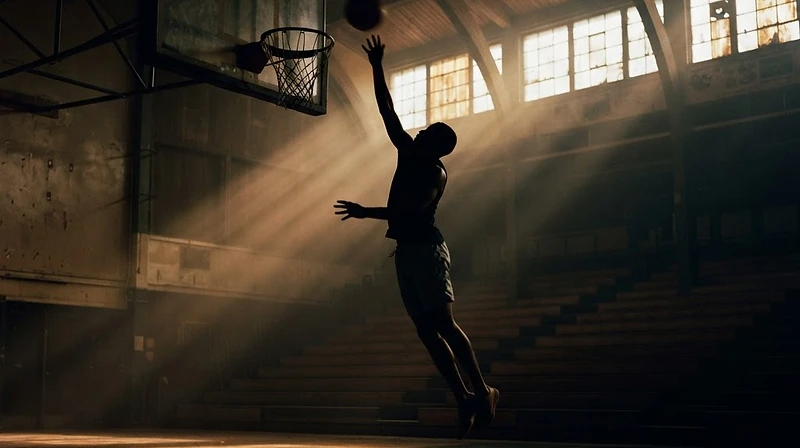
Dunk a Basketball
A dunk is not a gift of height. It is thirty-four inches of intent, built one ankle and one hip at a time.
But first, a little context and history...
Basketball was invented in 1891 by a physical education instructor who needed something to occupy a class of young men through a Massachusetts winter. James Naismith nailed a peach basket to a balcony rail, wrote thirteen rules, and specified that the ball was to be thrown — which is why, for the first half-century of the sport, the shot was the whole vocabulary.
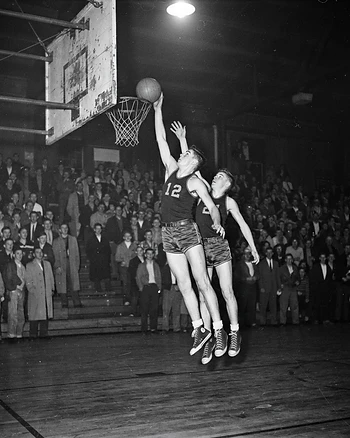
Dunking arrived almost immediately and was controversial from the start. Players in the 1930s and 1940s jumped and stuffed the ball in warm-ups and exhibitions, and by the 1950s it had become the signature of the tall, athletic big man in the professional game. College basketball banned it outright in 1967 — the so-called Alcindor rule, after Lew Alcindor, later Kareem Abdul-Jabbar, whose reach had made the dunk look unfair. The ban lasted nine years; the NCAA restored it in 1976 and the game changed shape overnight.
Television did the rest. Chick Hearn's phrase “slam dunk” entered the language, the ABA's red-white-and-blue theatrics made the aerial game a spectacle, and the 1980s brought the dunk contest, Julius Erving's flight from the free-throw line, and a generation of players who trained jumping as deliberately as they trained shooting. By the time Vince Carter went under the rim in 2000, the dunk had become the sport's most reliable piece of theatre: a two-second proof of athletic intent.
What the highlight reel never shows is the work. A dunk is a force problem before it is a skill problem. You need enough hip and ankle power to launch roughly thirty-four inches to touch the rim at all, and a little more to control the ball above it. That is trainable — not to professional levels, but genuinely — and the training is unglamorous: squat and hinge strength, calf and Achilles resilience, thousands of low-amplitude pogo hops, and landing mechanics that keep your knees intact. Plyometrics do not build power; they teach a body that already has it to release that power faster.
The honest version of this lab is that thirty days will change your jump measurably and get you a controllable dunk on a lowered rim, and will put a regulation rim within reach for many people who can already grab the net. It will not add fifteen inches. What it will do is teach you to jump properly, land safely, and measure the truth with a tape rather than a feeling — and if you are within a few inches, the last part of this lab is a plan for the months after it.
Approach matters as much as muscle. Most missed dunks are missed by the feet, not the legs: a gather that is a step too long, a penultimate stride that kills the transfer, a takeoff that turns a vertical leap into a long jump. This lab spends its first week on measurement and mechanics, its second on strength and elasticity, its third on the ball and the approach, and its fourth on putting the two together at a rim. The final week is spent at the rim itself, adjusting one variable at a time.
One caution, stated plainly: this is a high-impact pursuit. If you have knee, ankle or back history, or have not trained in years, get cleared before you start jumping on boxes. Every session in this archive ends with a landing, and the landing is what decides whether you are still doing this in a year.
“Height gets you to the rim. The last six inches are trained.”
What to gather
A graded list of gear — from the first honest kit to the tools of a life in the craft. The Novice kit is free; the deeper tiers open with membership.
Novice
The first kit — enough to begin honestly.
From novice to proficient
A thirty-day passage. Each node is a day. The terracotta fill marks the ground you have already covered.
Understanding the mechanics of the jump and how to measure your current standing reach versus rim height.
YouTubeThe Physics of the Vertical
Good DrillWhat is the difference between your standing reach and the rim height? How many inches do you need to gain?
Saved locally to your device


How the cohort practices today
The pulse is quiet — for now.
Be the first to document your Dunk a Basketball journey with #EmptyNexxter.