

Disc Golf
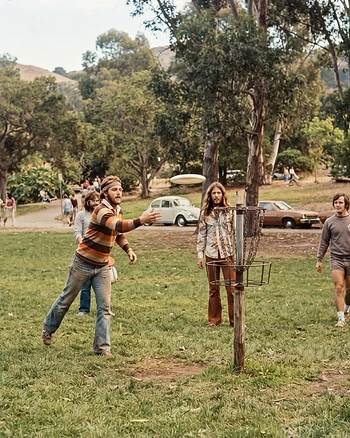
Frisbee grown up — a walk in the park with a thrower's challenge, where every tree is a hazard and every basket is a target.
But first, a little context and history...
Disc golf is golf played with flying discs instead of balls and clubs. You stand on a tee pad, throw a disc down a fairway, and count the throws it takes to land it in a metal basket. The lowest score wins. The mechanics are simple. The challenge is in the flight path, the wind, the trees, and the distance — a disc can fly 300 feet on a flat throw and curve left or right depending on its stability and your spin rate.
The game began informally in the 1960s, when George Sappenfield, a recreation counselor in Thousand Oaks, California, set up Frisbee golf games for children using trees and poles as targets. "Steady Ed" Headrick, an inventor at Wham-O, patented the first purpose-built disc golf target — the pole hole, a metal basket on a pole — in 1975. Headrick is often called the father of disc golf. He also designed the first purpose-built golf disc, the Professional Model, in 1983. The first permanent course was installed at Oak Grove Park in Pasadena in 1975, and it still exists today.
The Professional Disc Golf Association (PDGA) was founded in 1976 and now sanctions tournaments worldwide. The sport grew steadily through the 1980s and 90s but exploded in the 2010s, driven by cheap course access (most are free, in public parks), the social nature of the game, and the pandemic-era surge in outdoor recreation. By 2024 there were over 13,000 courses worldwide and the PDGA had more than 130,000 active members. The pro tour now streams on YouTube with commentary, and top players earn six figures.
The equipment is minimal. A starter set of three discs — a driver, a mid-range, and a putter — costs under $25. The discs are the craft: each has a different stability rating that determines how it curves in flight. A disc rated -2 will turn right (for a right-handed thrower), a disc rated +2 will fade left. Learning to match the disc to the shot — the distance, the wind, the gap in the trees — is the skill that separates the casual thrower from the player who shoots under par.
The throw itself is where the craft lives. The backhand drive, the forehand flick, the thumber roller — each is a different way to send a disc down a fairway. The run-up and the plant foot, the reach-back and the pull-through, the snap of the wrist at release — these are the mechanics of a 300-foot drive, and they take a season to learn and a lifetime to refine. The putt, a gentle loft into the chains from 30 feet, is the shot that wins tournaments and breaks hearts.
For the empty nester, disc golf is a walk in the woods with a purpose. It is low-impact, social, and free to play. It does not demand the arm it once did — the discs do the flying. It rewards a smooth, repeatable motion and a calm read of the wind. The first round is a scramble through the trees. The hundredth is a par you can feel in your shoulders. The course does not care how old you are. It only cares how well you can read the line.
“The course does not care how old you are. It only cares how well you can read the line.”
What to gather
A graded list of gear — from the first honest kit to the tools of a life in the craft. The Novice kit is free; the deeper tiers open with membership.
Novice
The first kit — enough to begin honestly.
Advanced
The serious tools of a committed hand.
Coming soon
Expert
The equipment of a life in the craft.
Coming soon
From novice to proficient
A thirty-day passage. Each node is a day. The terracotta fill marks the ground you have already covered.
Learn the rules, the objective, and the basic etiquette of disc golf. Understand the course layout — tee pads, fairways, and baskets — and how a round is scored.
YouTubeWhat Is Disc Golf?
Innova Disc GolfWhat was the most surprising rule or aspect of disc golf etiquette you learned today? How does the objective of the game compare to traditional golf?
Saved locally to your device


How the cohort practices today
The pulse is quiet — for now.
Be the first to document your Disc Golf journey with #EmptyNexxter.