
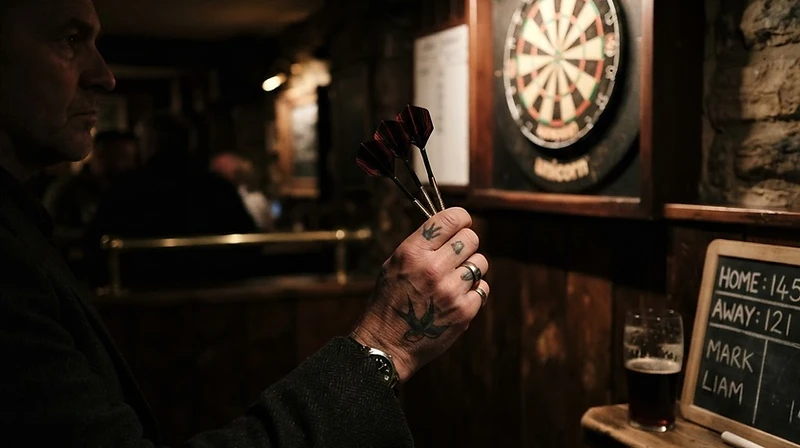
Darts
Precision, focus, and the quiet rhythm of the oche: master the centuries-old art of the dart.
But first, a little context and history...
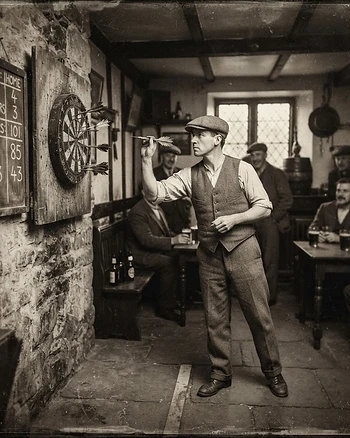
Darts occupies a unique space in recreational history, bridging the gap between medieval combat drills and modern professional sport. The activity finds its roots in the camaraderie of the longbowmen and crossbowmen of the Middle Ages. During long periods of stagnation in military camps, soldiers often engaged in spontaneous contests of skill, utilizing the shortened ends of broken arrows as makeshift projectiles. These were hurled at targets constructed from the tops of wine casks or cross-sections of tree trunks. As these veterans transitioned back into civilian life, they carried the game into the public houses of England, cementing the pub as the natural crucible for the sport's evolution.
The transition from a casual distraction to a structured discipline reached a major milestone in 1896. Before this, boards were often crudely crafted with inconsistent layouts. Brian Gamlin, a carpenter from Bury in Lancashire, is widely credited with designing the standardized numbering system still in use today. His design was ingenious in its psychological complexity. By placing high numbers like 20 next to low values like 1 and 5, Gamlin ensured that an inaccurate throw was heavily penalized. This arrangement demands constant focus and precision, effectively removing luck as a primary factor in success.
The equipment itself has undergone significant refinement to match the demands of modern competition. While early projectiles were fashioned from wood with metal points, the contemporary dart relies on high-density tungsten barrels. This material allows for a slimmer profile, meaning three darts can occupy the same treble-20 bed without the player risking a deflection. The setup includes four distinct components: the steel point, the weighted tungsten barrel, the flight-securing shaft, and the flight itself. Each player customizes these elements to suit their unique grip and throwing arc, turning the equipment into an extension of one’s own physical mechanics.
Today, the game is best known for the 501 format, a test of subtraction and strategic planning. Competitors begin at 501 and must reduce their total to exactly zero, finishing on a double. This requires a sharp mind capable of rapid mental arithmetic under the pressure of competition. It is less about raw power and more about the repetition of a fluid, consistent motion. The oche—the line from which players throw—serves as the boundary of a personal sanctuary, demanding complete mental presence for the duration of the match.
For the Gen X empty nester, darts offers an ideal intersection of low-impact physical movement and high-engagement mental stimulation. It requires no extensive athletic training, yet it rewards the kind of deep, meditative practice that many seek in their second act. Transforming a home office or garage into a private darting hall creates a space for introspection or friendly competition with house guests. The game respects age, rewarding those who cultivate patience and steady nerves over those who rely on youthful intensity. It is a hobby that grows with you, proving that the most rewarding challenges are often the ones we set for ourselves on the wall.
“Darts is a game of millimeters, where the final result is dictated not by brute strength, but by the calm synchronization of hand and mind.”
What to gather
A graded list of gear — from the first honest kit to the tools of a life in the craft. The Novice kit is free; the deeper tiers open with membership.
Novice
The first kit — enough to begin honestly.
From novice to proficient
A thirty-day passage. Each node is a day. The terracotta fill marks the ground you have already covered.
Understand the board: the 20 segments, the double and treble rings, the bull and bullseye. Tour the oche, the darts, the stance. Today is orientation; the throw begins tomorrow.
YouTubeThe Game and the Board
Mission DartsReflect on the layout of the board: which segment do you find most visually intimidating, and why?
Saved locally to your device


How the cohort practices today
The pulse is quiet — for now.
Be the first to document your Darts journey with #EmptyNexxter.