
Cyclocross
The winter sport the road racers invented — an hour in a field in the rain, a bike on the shoulder, and the hard thing that is the fun thing.
But first, a little context and history...
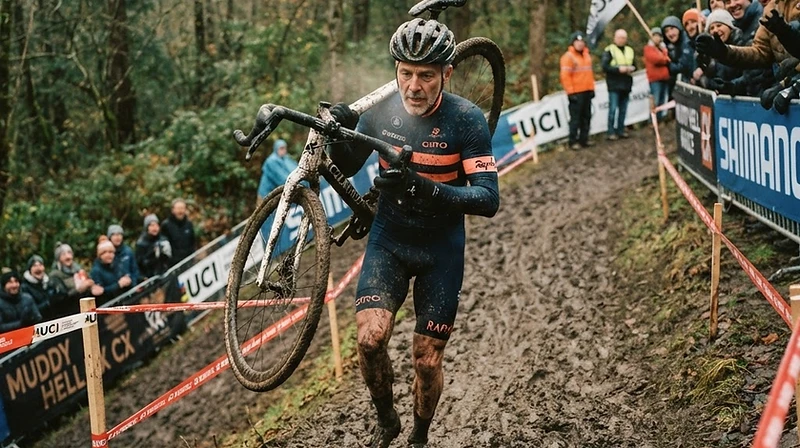
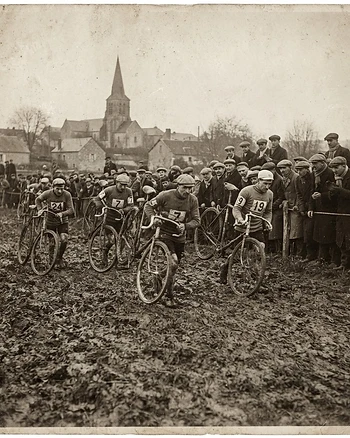
Cyclocross is the winter sport that road racers invented to stay fit when the roads were closed, and it is the strangest and the most demanding of the cycling disciplines. The sport began in France at the turn of the twentieth century, as a way for road racers to train through the winter when the roads were too cold, too wet, and too dark to ride. The first race that resembles cyclocross was the Critérium International de Cross-Country Cyclo-Pédestre, organized by Daniel Gouin in 1902 in the park of the Château de Saint-Cloud, on the western edge of Paris. The early races were not races on bikes so much as races with bikes: the course crossed fields, streams, fences, and ditches, and the rider who could carry his bike over the obstacles the fastest was the rider who won. The French called the carry the portage, and the portage is still the defining act of the sport.
The sport that began as winter training became a sport in its own right, and the first French national championship was held in 1902, the same year as Gouin's race. The first world championship was held in 1950 in Paris, and it was won by Jean Robic, a French rider who had won the Tour de France in 1947 and who was the first rider to show that cyclocross was not just a winter diversion but a discipline that demanded its own mastery. The sport's heartland has always been the low countries — Belgium, the Netherlands, and the north of France — where the winter is wet, the fields are soft, and the culture of cycling is deep. The Belgian championship has been held since 1910, and the Belgian riders have dominated the sport for most of its history: the names of the Belgian cyclocross champions — Roland Liboton, Eric De Vlaeminck, Sven Nys, Mathieu van der Poel — are the names the sport is built on. Eric De Vlaeminck won the world championship seven times between 1966 and 1973, a record that has never been broken, and his brother Roger won the cyclocross world championship and the Tour of Flanders in the same year.
The bike that the sport uses is the cyclocross bike, which is a road bike adapted for the off-road. The frame is a road frame with more clearance for wider tires — the maximum tire width is 33 millimeters, which is the rule that defines the sport — and with cantilever or disc brakes that work in the mud. The gears are lower than a road bike, because the courses are slow and the resistance is high, and the single chainring drivetrain that is now common in cyclocross was borrowed from mountain biking in the 2010s. The pedals are the clipless pedals of the road, but the shoes are the mountain bike shoes with the tread that lets the rider run through the mud. The tire is the cyclocross tire, which is a narrow tire with a file tread for the hard parts of the course and knobs for the soft parts, and the choice of tire is the choice that decides the race.
The course that the sport is raced on is a closed loop of one to three kilometers, which the rider laps for an hour, and the hour is the race's defining constraint: a cyclocross race is not a distance but a time, and the rider who completes the most laps in the hour is the winner. The course is a mix of grass, mud, sand, gravel, and pavement, and it is interrupted by barriers — low wooden boards that the rider must dismount and jump over, carrying the bike — and by run-ups, which are the steep hills that the rider must run up with the bike on the shoulder. The dismount and the remount are the sport's signature skills, and the rider who can dismount, run, and remount without losing speed is the rider who wins. The sport is the only cycling discipline in which the rider spends a significant part of the race not on the bike, and the portage is the reason cyclocross is the most athletic of the cycling sports.
For the empty nester, cyclocross is the rare sport that is as much a game as a race. The courses are short, the races are an hour, the atmosphere is a festival — the Belgian fans call it a cross, and a cross is a party in a field in the rain — and the sport is the one cycling discipline that rewards agility and nerve as much as endurance. The bike that was a road bike for the winter is now a machine of its own, and the course that was a farmer's field is now a stage. The lesson the empty nest is teaching you — that the hard thing is the fun thing — is the lesson cyclocross has been teaching for a hundred years.
“A cyclocross race is not a distance but a time, and the rider who completes the most laps in the hour is the winner.”
What to gather
A graded list of gear — from the first honest kit to the tools of a life in the craft. The Novice kit is free; the deeper tiers open with membership.
Novice
The first kit — enough to begin honestly.
Intermediate
The upgrades that change how it feels.
Coming soon
Advanced
The serious tools of a committed hand.
Coming soon
Expert
The equipment of a life in the craft.
Coming soon
From novice to proficient
A thirty-day passage. Each node is a day. The terracotta fill marks the ground you have already covered.
Gouin's 1902 race, the portage, Robic, De Vlaeminck, Nys, van der Poel. Know the lineage of the sport and the low countries that made it.
YouTubeWhat Cyclocross Is
124 CyclingHow does the historical evolution of cyclocross from a winter training tool for road racers influence the way you view the sport today?
Saved locally to your device


How the cohort practices today
The pulse is quiet — for now.
Be the first to document your Cyclocross journey with #EmptyNexxter.