

Understanding Cryptocurrency, Blockchain and Tokenization
From the Bitcoin whitepaper to tokenized everything — a guided passage through digital trust.
But first, a little context and history...
The roots of cryptocurrency stretch back to the cypherpunk movement of the 1990s — a loose collective of cryptographers and privacy advocates who believed strong cryptography could forge a more free society. Early attempts at digital cash, including David Chaum's DigiCash (1990) and e-gold (1996), failed for regulatory and technical reasons, but they planted the seed: money could exist as pure information.
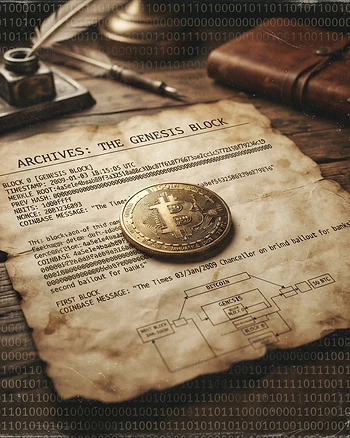
The breakthrough came in the wake of the 2008 financial crisis, when trust in banks and central authorities was at a generational low. On October 31, 2008, Satoshi Nakamoto published 'Bitcoin: A Peer-to-Peer Electronic Cash System.' The paper proposed a solution to the 'double-spending problem' that had defeated all prior digital currencies: a distributed ledger, secured by proof-of-work mining, in which every participant independently verifies every transaction. The network's genesis block was mined on January 3, 2009, embedded with a newspaper headline: 'The Times 03/Jan/2009 Chancellor on brink of second bailout for banks.'
Bitcoin proved that a trustless, decentralized currency could function. But the deeper innovation was the blockchain itself — a tamper-evident, append-only ledger that requires no central operator. In 2015, Ethereum launched with a more ambitious vision: a blockchain that could run code. Smart contracts — self-executing agreements written directly into the ledger — opened the door to decentralized finance (DeFi), autonomous organizations (DAOs), and non-fungible tokens (NFTs).
Tokenization emerged as the natural extension: if a blockchain could represent a coin, it could represent anything — art, real estate, concert tickets, loyalty points, shares in a company. The token became a primitive for encoding ownership, rights, and value in a single portable, verifiable unit.
The space has been marked by cycles of speculation, fraud, and genuine innovation. Exchange collapses (Mt. Gox in 2014, FTX in 2022), regulatory whiplash, and environmental debates have all shaped the landscape. Yet the underlying technologies — public-key cryptography, distributed consensus, and programmable ledgers — have steadily migrated into mainstream finance, supply chains, and institutional infrastructure. Understanding cryptocurrency today means understanding a still-young field where the line between breakthrough and bubble is often visible only in retrospect.
“Money is the oldest social technology we have. Cryptocurrency is the first attempt to rebuild it from first principles.”
What to gather
A graded list of gear — from the first honest kit to the tools of a life in the craft. The Novice kit is free; the deeper tiers open with membership.
Novice
The first kit — enough to begin honestly.
From novice to proficient
A thirty-day passage. Each node is a day. The terracotta fill marks the ground you have already covered.
Understanding the historical context of the 2008 financial crisis and the birth of Bitcoin.
YouTubeThe Genesis of Digital Trust
3Blue1BrownWhy did Satoshi Nakamoto believe that trust in institutions was the root problem of conventional currency?
Saved locally to your device


How the cohort practices today
The pulse is quiet — for now.
Be the first to document your Understanding Cryptocurrency, Blockchain and Tokenization journey with #EmptyNexxter.