
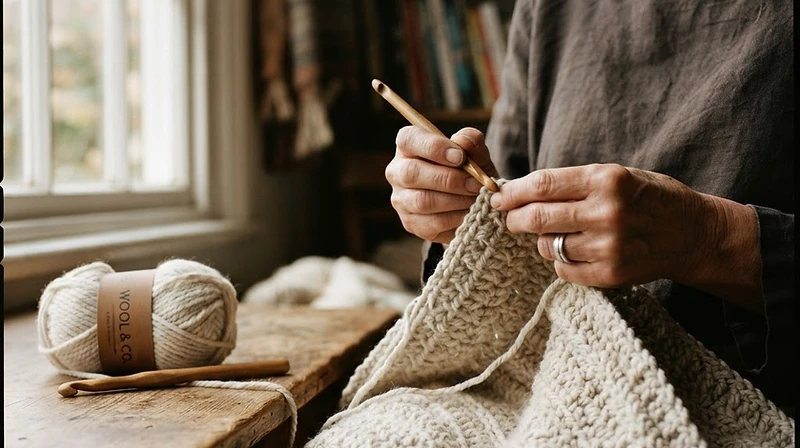
Crochet
The infinite loop: transforming a single strand of fiber into structure, warmth, and legacy.
But first, a little context and history...
Crochet is the alchemy of a single hook and a continuous thread. Unlike knitting, which requires multiple needles to hold live stitches, crochet forms fabric by pulling loops of fiber through one another, creating a durable, interlocking structure. It is the youngest of the traditional needle crafts, yet it possesses a versatility that has allowed it to mirror the social and economic shifts of the last two centuries. For the Gen X empty nester, crochet offers more than a creative outlet; it provides a meditative, tactile rhythm that grounds the mind during life's major transitions, rewarding patience with tangible beauty. The history of the craft is often debated, with two primary lineages shaping its identity. The tambour theory suggests it evolved from a 1700s style of French chain-stitch embroidery, where a fine hook was used to decorate stretched fabric. Eventually, makers discarded the cloth base, working the chain stitches directly into the air. Simultaneously, the shepherd's-knitting theory points to primitive, hook-based methods used by laborers in the Scottish Highlands and Scandinavia. These methods utilized simple tools to create sturdy, looped garments for daily use. By 1823, the first formal instructions appeared in the Dutch magazine Pénélope, and within two decades, pattern books were circulating throughout France and England, cementing crochet as a distinct domestic pursuit. The true economic awakening of the craft occurred during the Irish Potato Famine of the 1840s. As families faced devastating hardship, crochet became a literal lifeline. Convents, such as those run by the Ursuline nuns in Cork, taught girls and women to recreate expensive Venetian lace patterns using cotton thread and a steel hook. These intricate, motif-based pieces—often featuring delicate roses, leaves, and shamrocks—were sold to the affluent markets of Europe and America. This era transformed a casual pastime into a vital source of income, proving that the humble hook could support entire households. Today, the craft has shed its utilitarian origins for a more expressive role. Following the bohemian resurgence of the 1960s and 70s, when the iconic granny square became a symbol of counter-culture design, crochet has seen a sophisticated modern revival. Artists now use high-end wools, linens, and silks to create structural garments and intricate home decor that rival fine tailoring. For the contemporary hobbyist, the barrier to entry is delightfully low. A beginner needs only an ergonomic aluminum or wooden hook, a skein of natural yarn, and a quiet space to practice. The technical skills are forgiving; mastering basic stitches like the chain, single, and double crochet allows for an endless array of projects. Whether you are crafting a weighted heirloom blanket for your living room or a lightweight wrap for evening outings, the process encourages a slow, intentional pace of life. As you transition into your next chapter, this craft invites you to slow down, disconnect from digital noise, and build a collection of work that carries the mark of your own hands. Crochet rewards the curious spirit, turning the quiet hours of a Sunday afternoon into a productive, creative sanctuary. It is a hobby that grows with you, demanding only your focus and offering in exchange a sense of accomplishment that never fades.
“With just a hook and a ball of yarn, you possess the power to build something from nothing—one deliberate stitch at a time.”
What to gather
A graded list of gear — from the first honest kit to the tools of a life in the craft. The Novice kit is free; the deeper tiers open with membership.
Novice
The first kit — enough to begin honestly.
Advanced
The serious tools of a committed hand.
Coming soon
Expert
The equipment of a life in the craft.
Coming soon
From novice to proficient
A thirty-day passage. Each node is a day. The terracotta fill marks the ground you have already covered.
Understand the trinity: hook, yarn, stitch. Hold the hook (pencil or knife grip) and the yarn, and learn to tension the yarn through the fingers. Today is orientation; the stitching begins tomorrow.
YouTubeThe Craft and the Hook
Crochet with CarrieHow does your chosen grip feel in your hand, and which tension method feels most natural for controlling your yarn flow?
Saved locally to your device


How the cohort practices today
The pulse is quiet — for now.
Be the first to document your Crochet journey with #EmptyNexxter.