
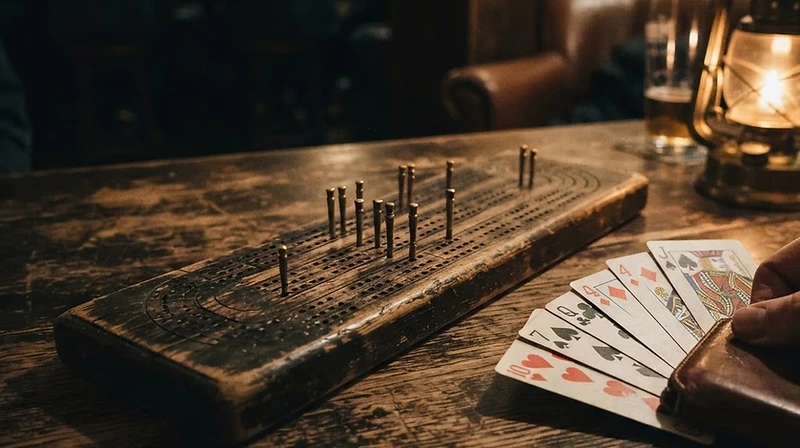
Cribbage
A pub game invented by a poet, played with pegs and a deck of cards — easy to learn in an afternoon, deep enough to argue about for the rest of your life.
But first, a little context and history...
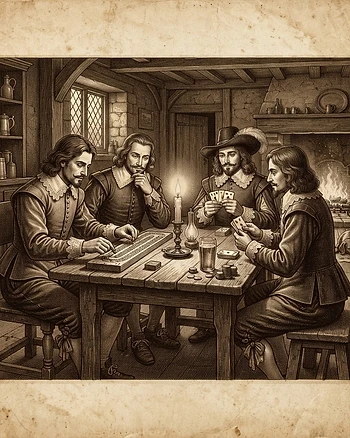
Cribbage was born in a gambling house. Sir John Suckling — poet, courtier, soldier, and the most notorious card sharp of 17th-century England — is credited with inventing the game around 1632 by refining an older pastime called noddy. Nodsey was played with a knave turned up as the starter card; Suckling added the crib, the five-card hand discarded to the dealer, and the distinctive scoring board with its rows of holes pegged in sequence. The story, likely embellished but too good to lose, is that Suckling traveled the country winning at his own game by distributing marked decks to the gentry beforehand. He died at 33, possibly by his own hand, but his game outlived him by four centuries and counting.
The game spread through the taverns and port towns of England. Sailors carried it to sea; by the 18th century it was the standard game of the Royal Navy, and American whalers and submariners adopted it in turn. The U.S. Navy still keeps a cribbage board aboard every submarine — the oldest crew member is the keeper of the board, a tradition that runs back to the Second World War. In port towns from Gloucester to Devon, the cribbage board was the center of the evening: a game that could be played in the time it took to finish a pint, scored in plain sight so no one could cheat, and complicated enough to keep the talk going.
Cribbage is a game of arithmetic and memory. The deck is standard fifty-two. Each player is dealt six cards and discards two to the crib, which belongs to the dealer. A starter card is cut from the deck. Players play their cards out in sequence, scoring for combinations that total fifteen, for pairs and runs, and for reaching thirty-one. In the show, each hand is counted for fifteens, pairs, runs, and flushes, with the jack of the starter card's suit — the 'heels' — worth a point. The board is the record: 121 holes, pegged in a race, first to the end wins. A skunk — losing by more than thirty points — is a humiliation that has its own name.
What makes cribbage endure is that it is both social and solitary. The board sits between you and your opponent, but the counting is done in your head, and the counting is the game. A good cribbage player sees fifteens the way a good chess player sees forks — instantly, without thinking. The empty nester finds in cribbage what generations of sailors and pub-goers found before: a game that fits in a drawer, takes a lifetime to master, and is best played with someone you like enough to lose to.
“A game that fits in a drawer, takes a lifetime to master, and is best played with someone you like enough to lose to.”
What to gather
A graded list of gear — from the first honest kit to the tools of a life in the craft. The Novice kit is free; the deeper tiers open with membership.
Novice
The first kit — enough to begin honestly.
From novice to proficient
A thirty-day passage. Each node is a day. The terracotta fill marks the ground you have already covered.
Understanding the board layout, pegging mechanics, and the objective of reaching 121 points.
YouTubeIntroduction to the Cribbage Board
Prague Golf & GamesHow does the physical act of pegging change the feel of the game compared to paper scoring?
Saved locally to your device


How the cohort practices today
The pulse is quiet — for now.
Be the first to document your Cribbage journey with #EmptyNexxter.