
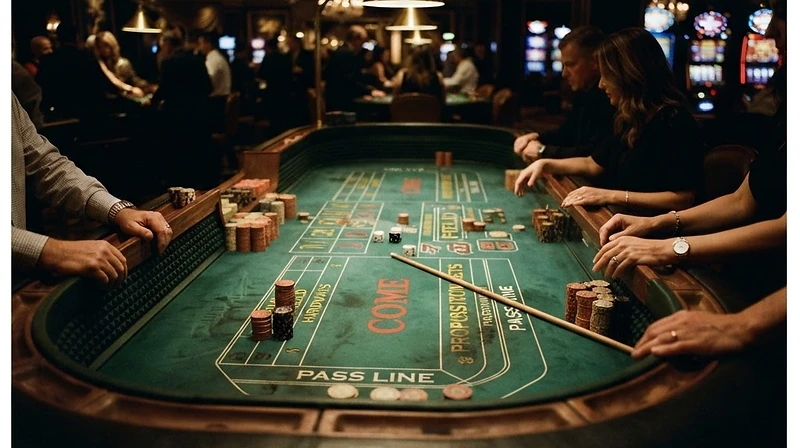
Craps
A dice game played in public, where the roar of the table is half the point.
But first, a little context and history...
Craps descends from hazard, an English dice game whose name traveled through French as hasard and whose roots reach further back to an Arabic word for dice, al-zahr. By the eighteenth century hazard was the ruin of half of London's gentry, played with two dice, a calling box and a set of arcane calls that a generation of gamblers knew by heart. It crossed the Atlantic with the English, took root in New Orleans, and was renamed for the losing throw: craps, from the French crapaud, the toad, for the way a bad roll squats on the table.
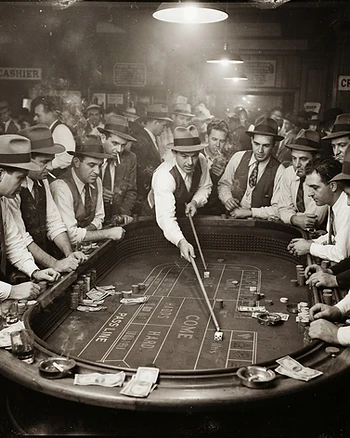
In 1813 a young Creole aristocrat named Bernard de Marigny, gambling away his inheritance in the Faubourg Marigny, simplified hazard into the game you would recognize today. He removed the most punishing throws and left behind the essential cycle: a come-out roll, a point, and the long anxious wait for the shooter to make it. Craps was a street game for most of the nineteenth century, played on a blanket in a lot, with the dice passed hand to hand.
The transformation came when John H. Winn, a dice maker in New York, added the Don't Pass line. For the first time a bettor could stand against the shooter, which meant the house no longer had to police the game and could simply take its cut from both sides. That single innovation turned craps from a hustler's contest into a house game, and from there into the layout you see in every American casino.
The game spread through the First World War and, more decisively, the Second, when American servicemen played it in barracks and on transports and brought it home to every downtown in the country. Las Vegas built its pit around it. By the 1950s a hot craps table was the loudest place in Nevada, and the culture that forms around it, the shooters and the wrong bettors, the stickman's patter and the chorus of groans, became as much a part of the game as the dice.
What has never changed is the odd social contract of craps. It is a solo bet placed in a crowd, a private wager that somehow makes everyone at the rail a participant. No other game in the casino asks strangers to celebrate each other's luck. The math, in the end, is straightforward; the theater is not.
“Craps is the only game in the casino where the crowd is part of the odds.”
What to gather
A graded list of gear — from the first honest kit to the tools of a life in the craft. The Novice kit is free; the deeper tiers open with membership.
Novice
The first kit — enough to begin honestly.
From novice to proficient
A thirty-day passage. Each node is a day. The terracotta fill marks the ground you have already covered.
A four-minute orientation to craps: the table, the bets, and the shape of a single round.
YouTubeThe Fastest Game in the Casino
Color UpWhat surprised you most about how a round of craps actually works?
Saved locally to your device


How the cohort practices today
The pulse is quiet — for now.
Be the first to document your Craps journey with #EmptyNexxter.