
Cornhole
A backyard toss with a thousand-year arc — four bags, two boards, and a throw that rewards the quiet hand over the strong arm.
But first, a little context and history...
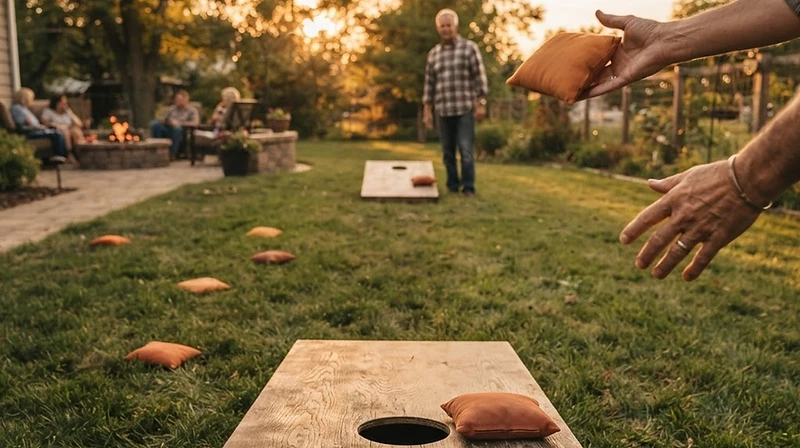
Cornhole is a game of four bags, two boards, and one honest throw. You stand twenty-seven feet from a slanted board, loft a corn-filled sack toward a six-inch hole, and watch it either drop cleanly through the hole for three points or slide onto the board for one. That is the whole game. The simplicity is the point — and the trap.
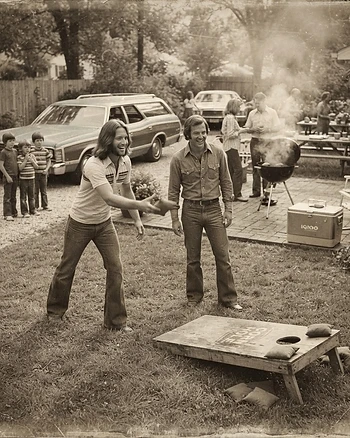
The toss has older roots than most players guess. Medieval Germans threw bean bags at holes in the ground as a fairground diversion. The game crossed the Atlantic with German immigrants and settled in the Ohio River valley, where a Kentucky farmer, so the story goes, stuffed dried corn into cloth sacks and propped a board against a tree to keep his children occupied. The name "cornhole" stuck. For a century it lived at church picnics, tailgates, and family reunions — a game nobody organized and everybody knew.
The craft found its modern shape in 1990s Cincinnati, where bar leagues turned a picnic game into a bracketed sport. The American Cornhole Association formed in 2003, the American Cornhole League followed, and by the 2010s the sport had televised tournaments, sponsored players, and a touring pro circuit. What had been a lawn diversion became a pursuit you could take seriously — or not, which is the other half of its charm.
The equipment is modest. Two boards, each two by four feet, angled so the back edge rises a foot off the ground, with a hole centered nine inches from the top. Eight bags — four per player — each weighing roughly sixteen ounces, traditionally filled with feed corn though resin pellets now dominate. The boards are set twenty-seven feet apart, hole to hole. That is the entire inventory. A garage, a lawn, and a set of bags is all the workshop the game requires.
The throw itself is where the craft lives. The flat, underhand toss with a single rotation — the "slide shot" — aims to land the bag just past the hole and let it slide back into it. The "airmail" is the riskier arc that drops straight in. The "blocker" lands short to guard the hole. Reading the board — its finish, its angle, the wind across the lawn — is the quiet skill that separates the casual tosser from the player who wins the bracket. The stance is low and still; the release is a flick, not a heave.
For the empty nester, cornhole is a craft that meets you where you are. It does not demand youth or strength. It rewards a steady hand, a patient eye, and the willingness to throw a hundred bags to learn what the hundredth will do. The first toss is a fumble. The hundredth is a slide you can feel in your fingers. The game travels well — to a grandchild's birthday, a neighbor's cookout, a tailgate in autumn — and it gives you, at the end of an afternoon, a small mastery that costs nothing but attention. The board does not care how old your arm is. It only cares how steady your hand is.
“The board doesn't care how old your arm is. It only cares how steady your hand is.”
What to gather
A graded list of gear — from the first honest kit to the tools of a life in the craft. The Novice kit is free; the deeper tiers open with membership.
Novice
The first kit — enough to begin honestly.
From novice to proficient
A thirty-day passage. Each node is a day. The terracotta fill marks the ground you have already covered.
Understand the craft: the bag, the board, the throw, the stance. Tour the board and the lawn. Today is orientation; the toss begins tomorrow.
YouTubeThe Craft and the Lawn
Cornhole CoupleReflect on the basic setup of the game. How does understanding the dimensions of the board and the distance of the pitch change your perspective on the game?
Saved locally to your device


How the cohort practices today
The pulse is quiet — for now.
Be the first to document your Cornhole journey with #EmptyNexxter.