
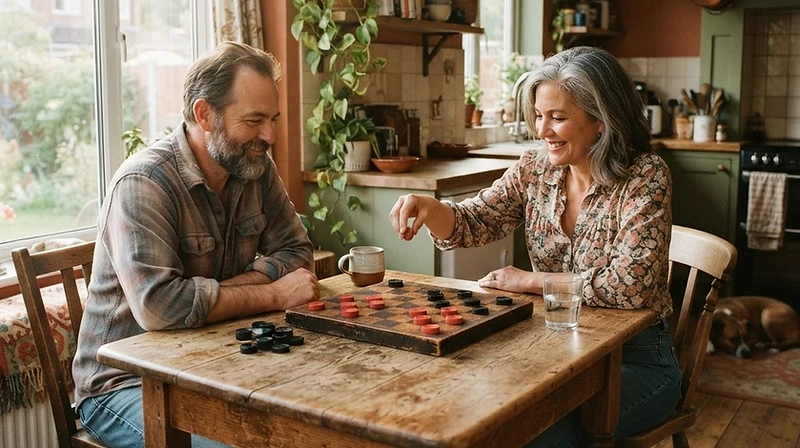
Checkers
The simplest board in the house — and one of the hardest games in the world.
But first, a little context and history...
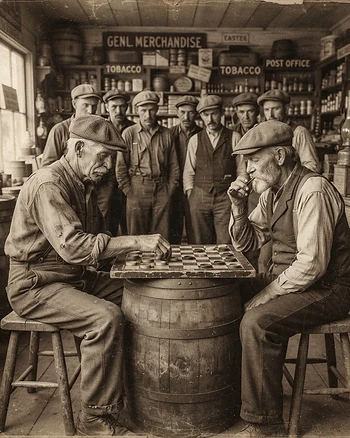
Checkers is older than the alphabet. The earliest board game we know by name, Alquerque, was played in Egypt around 1400 BCE on a board of five-by-five lines cut into the stone blocks of a temple roof at Thebes. The pieces moved along the lines and captured by jumping. When the Arabs took Alquerque west and north, it met the chessboard — the 8-by-8 board we still use — and the two married in the south of France sometime around 1100. The new game was called dames, and it is the parent of every modern form of checkers.
The game crossed the Channel to England, where it became draughts, and the Atlantic to America, where it became checkers. The rules hardened slowly. The compulsory capture — you must take a piece when you can — was added in France in the 1530s. The king, a piece that reaches the last rank and is crowned, is older; the flying king, which moves any distance along a diagonal, is the Spanish and Dutch contribution of the 16th century. The game the empty nester learned as a child is, in its bones, the game of medieval France.
What sets checkers apart is that it was solved. In 2007, after eighteen years of work, a team at the University of Alberta announced that the game of checkers — played perfectly by both sides — ends in a draw. Every one of the 500 billion possible positions has been computed. A perfect game cannot be won and cannot be lost. The computer does not play checkers anymore; it has finished it. The human game, of course, goes on — because no human plays perfectly, and the art of checkers is the art of the small edge that, against another imperfect player, becomes a win.
The American game produced its great players. Marion Tinsley, a mathematics professor from Ohio, is considered the greatest checkers player who ever lived; between 1955 and 1991 he lost exactly seven tournament games. The world championship match between Tinsley and the Chinook computer program in 1992 is the only time a human has played a machine for a world title in a board game and held it to a draw. Tinsley won two games and lost two; the rest were draws. He died in 1995. For the empty nester, checkers is the game of a lifetime returned to — the rules you learned at the kitchen table, the depth you never guessed at, and the quiet truth that the simplest board in the house hides one of the hardest games in the world.
“The computer does not play checkers anymore; it has finished it. The human game goes on.”
What to gather
A graded list of gear — from the first honest kit to the tools of a life in the craft. The Novice kit is free; the deeper tiers open with membership.
Novice
The first kit — enough to begin honestly.
From novice to proficient
A thirty-day passage. Each node is a day. The terracotta fill marks the ground you have already covered.
The 32 dark squares, the 12 pieces each, the two rows. The board is smaller than chess and the rules are fewer — but the game is deep.
YouTubeThe Board & the Men
Cardboard Crash CourseReflect on the board layout: why do you think the game is restricted to only one color of squares, and how does this limit the movement of your pieces?
Saved locally to your device


How the cohort practices today
The pulse is quiet — for now.
Be the first to document your Checkers journey with #EmptyNexxter.