
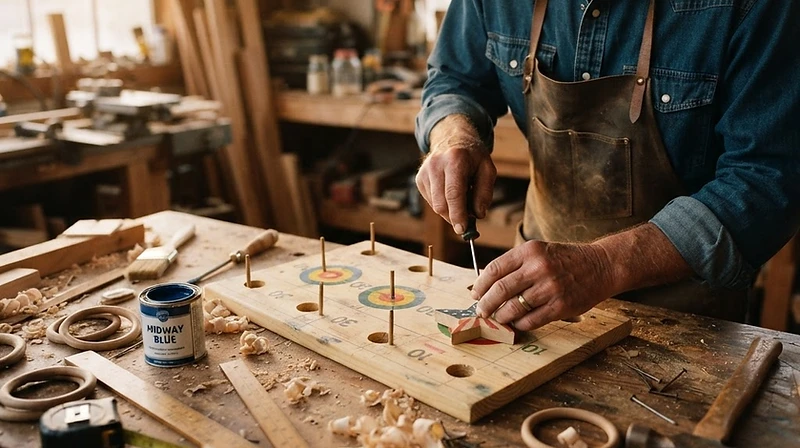
Carnival Games
Master the midway: Crafting the vibrant, nostalgic allure of classic carnival games in your own workshop.
But first, a little context and history...
The history of the modern carnival game finds its true genesis in the 1893 Chicago World’s Columbian Exposition. This global event introduced the concept of the 'Midway Plaisance,' a strip dedicated to entertainment, thrills, and skill-based trials that captured the public imagination. Makers at the time utilized pine, canvas, and vibrant oil-based pigments to create booths that functioned as both architectural marvels and interactive puzzles. These early structures were designed to be portable, modular, and visually arresting, establishing a design language that prioritized high-contrast colors and simple, enticing mechanics like the ring toss or the milk bottle pyramid. The craftsmanship required to build these attractions demanded a blend of precise carpentry and showman-level artistry.
By the 1920s, the traveling carnival movement standardized the 'game booth' into the iconic form we recognize today. Entrepreneurs began refining the ergonomics of play, ensuring that a game was accessible enough for a child to enjoy but sufficiently difficult to necessitate skill. During this era, the iconic 'barker' system evolved alongside the physical architecture of the booths. Skilled woodworkers became prized members of the carnival circuit, capable of constructing a durable, weather-resistant attraction in a matter of days. These individuals understood that the secret to a successful game lay in the aesthetic presentation—the hand-lettered signs, the bold color palettes, and the balanced weight of the game components themselves.
The mid-20th century, specifically the 1950s, saw these games transition from the traveling midway to the fixed environment of the suburban church bazaar and the neighborhood carnival. This shift democratized the hobby, inviting amateur woodworkers to replicate professional-grade booths for local fundraisers and backyard festivities. This era cemented the image of the game booth as a community cornerstone. Families gathered to refine their aim, and the construction of these games became a popular weekend project for fathers and hobbyists seeking to bring a touch of the extraordinary to everyday life.
Today, building carnival games offers a unique, fulfilling outlet for the Gen X empty nester. It provides a tactile escape from the digital monotony of the modern workplace, requiring focus, patience, and a hands-on mastery of materials. You are not just building a structure; you are engineering a mechanism of joy. This hobby balances creative expression—through paint, font design, and decoration—with the structural challenges of joinery and counterweight balancing. It is a pursuit that demands a workshop, a set of hand tools, and a bit of ingenuity.
Getting started requires minimal investment beyond plywood, standard lumber, high-quality acrylic enamels, and basic fasteners. You might begin with a classic 'Bottle Toss' or a 'Ring Toss' frame, focusing on stability and finish. As your confidence grows, you can move toward more complex builds featuring tiered shelves, weighted drop-targets, or even simple mechanical triggers. The goal is to produce equipment that feels authentic to the vintage aesthetic—sturdy, bright, and endlessly playable.
Beyond the assembly process, this hobby invites a deeper engagement with American social history. Researching the ornate typography and color schemes of 19th-century fairgrounds allows you to infuse your projects with genuine period character. Each finished game serves as an invitation for family and friends to step away from screens and engage in a shared, physical challenge. The satisfaction of watching a guest successfully land a toss on a board you sanded, painted, and assembled is unparalleled.
For those entering this new phase of life, carnival game construction serves as an ideal bridge between heritage craft and contemporary leisure. It is an exploration of geometry, physics, and art that fits perfectly into a well-equipped home garage or shed. By reclaiming the traditions of the early 20th-century artisan, you preserve a piece of cultural history while simultaneously crafting a legacy of entertainment for the next generation.
“A perfectly weighted ring or a custom-painted backdrop transforms raw lumber into a portal of nostalgia. The joy is entirely in the build.”

What to gather
A graded list of gear — from the first honest kit to the tools of a life in the craft. The Novice kit is free; the deeper tiers open with membership.
Novice
The first kit — enough to begin honestly.
From novice to proficient
A thirty-day passage. Each node is a day. The terracotta fill marks the ground you have already covered.
Understand the craft: the wood, the paint, the prize, the game. Tour the midway and the booth. Today is orientation; the build begins tomorrow.
YouTubeThe Craft and the Midway
PrextexReflect on the atmosphere of a carnival midway; what specific elements make a game booth feel inviting and exciting to a player?
Saved locally to your device


How the cohort practices today
The pulse is quiet — for now.
Be the first to document your Carnival Games journey with #EmptyNexxter.