
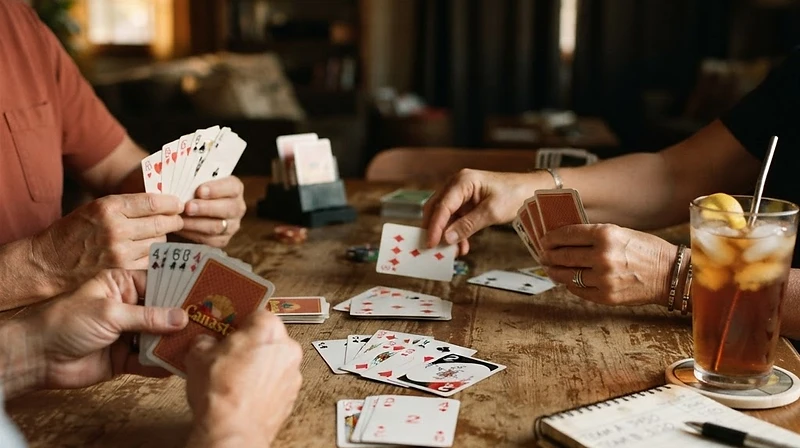
Canasta
Two decks, four players, and a score pad that rewards the patient over the clever.
But first, a little context and history...
Most card games have a fog for a birth certificate. Canasta has a date and two names. In 1939, in Montevideo, Uruguay, Segundo Santos and Alberto Serrato began tinkering with rummy: they doubled the deck, added jokers, and — the radical move — let a player pick up the entire discard pile if the card they melded matched the card on top of it. The game was refined among friends at the Jockey Club and given the name for the shallow basket, the canasta, in which the undealt stock was kept.
The name stuck, and so did the shape of the thing. Two standard decks plus four jokers make a hundred and eight cards. Eleven are dealt to each of four players in two partnerships; the rest become the stock. Players meld sets of three or more of a rank, wild cards are limited to threes per meld, and the object of the game is the canasta itself: seven cards of a rank laid down together. A natural canasta, with no wild cards in it, is worth five hundred points. A mixed one, three hundred. Everything else — the melds, the red threes, the cards left in your hand when someone goes out — is arithmetic in service of those two numbers.
What separated canasta from the rummy games it grew out of was the pickup rule and its companion, the freeze. Because the discard pile is a shared, growing asset, throwing a card away is never a neutral act. You are either feeding your opponents a meld or denying them one. The freeze — triggered when a wild card or a red three lands on the pile — closes the pile to all but a natural pair, and the whole table's plans reorganise around it. It is a game of small, cumulative decisions, and the player who makes the better boring choice most often wins.
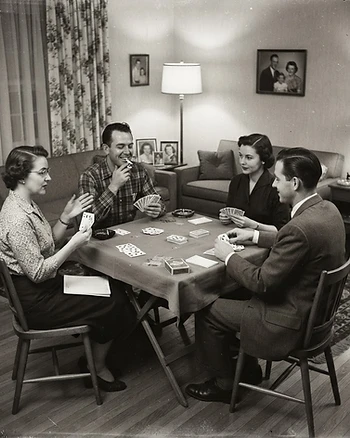
From Montevideo the game travelled north through Brazil and Argentina, and in the late nineteen forties it landed in the United States. By 1950 it was a full-blown mania. Newspapers ran daily canasta columns, department stores sold special tables and card trays, and hostesses scheduled canasta evenings the way their mothers had scheduled bridge. Estimates at the height of the craze put the number of American players in the tens of millions, and for a season or two canasta was genuinely said to be supplanting bridge as the country's parlour game — the game of the new suburban living room rather than the old club.
Craze or not, the game outlasted the fuss. It scattered into a family of variants: Samba adds a third deck and sequences; Bolivia tightens the deck and the meld requirements; Hand and Foot deals two piles per player and has become its own household institution across the American South and Midwest; Cuban and Brazilian canasta keep the Latin roots visible. Almost every family that plays plays a slightly different version, and the arguments about house rules are older than most of the players having them.
What the game asks of you is modest and specific: remember what has been played, count the wild cards, understand the meld thresholds that rise as the score climbs, and keep your partnership's hand a joint project rather than two private ones. There is luck in the deal — a hand full of red threes will ruin an afternoon no matter how well you play it — but the forty-year player is not winning because of the deal.
The gear is a table and two decks. The rest is attention, and a partner you can read. Before you begin, one caution: canasta is a partnership game with a scoring sheet, which means it is a game that can be played badly in ways that hurt the other person's feelings. Agree the rules before the first deal, agree the stakes before the second, and do not argue about a freeze you can no longer prove.
“Every card game is a small economy. Canasta's is the one built for company.”
What to gather
A graded list of gear — from the first honest kit to the tools of a life in the craft. The Novice kit is free; the deeper tiers open with membership.
Novice
The first kit — enough to begin honestly.
From novice to proficient
A thirty-day passage. Each node is a day. The terracotta fill marks the ground you have already covered.
Learn the objective of the game, the 108-card deck composition, and the basic flow of a turn.
YouTubeIntroduction to Canasta Basics
SPIELREGELN TVHow does the partnership dynamic change your approach compared to solo card games?
Saved locally to your device


How the cohort practices today
The pulse is quiet — for now.
Be the first to document your Canasta journey with #EmptyNexxter.