

Bungee Jumping
Defy the horizon: rediscover your pulse through the timeless art of the free fall.
But first, a little context and history...
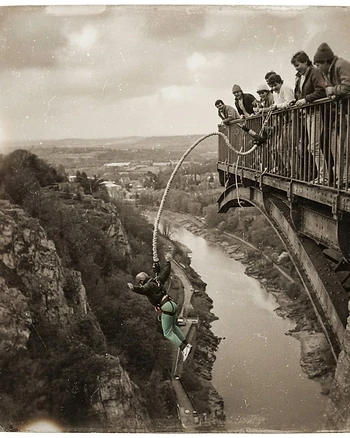
Bungee jumping stands as a profound testament to the human desire to master the vertical world. While its modern form emerged in the late 20th century, the activity traces its philosophical lineage to the ancient Naghol land divers of Pentecost Island, who practiced ritualistic leaps from wooden towers to ensure a bountiful yam harvest. This primal impulse to trade stability for momentum has always lived within the adventurous spirit, waiting for the right moment to migrate from ritual to recreation. For the modern empty nester, this hobby represents a reclamation of agency, a visceral reminder that the second act of life is meant to be met with boldness rather than passive observance. The journey toward becoming a jumper begins in the archives of late-1970s Britain. On April 1, 1979, members of the Oxford University Dangerous Sports Club scaled the 245-foot Clifton Suspension Bridge in Bristol. Using braided rubber ropes, these pioneers challenged the boundaries of human endurance. While their methods were rudimentary compared to today’s standards, they successfully bridged the gap between daredevil ambition and organized adventure. Their willingness to embrace the edge set the stage for a revolution in extreme leisure. The true transformation occurred nearly a decade later in the Southern Hemisphere. In 1988, A.J. Hackett and Henry van Asch opened the world's first permanent commercial bungee site at the Kawarau Bridge in New Zealand. By perfecting the use of specialized latex cordage and rigorous safety protocols, they elevated a fringe stunt into a regulated, accessible industry. This shift allowed everyday explorers to experience the profound clarity found in the moments between the jump and the rebound. Today, the infrastructure of the sport is remarkably sophisticated. High-tensile elastic ropes, redundant harness systems, and precise aerodynamic calculations ensure that every descent is controlled. Practitioners now frequent iconic sites ranging from the Bloukrans Bridge in South Africa to the Macau Tower in China. The equipment—a blend of mountaineering gear and bespoke polymer elastic—is engineered to distribute deceleration forces evenly across the body. As you ascend to the launch platform, the specialized latex core serves as the literal and figurative tether to your safety, absorbing the kinetic energy of your fall with scientific precision. For those of us navigating the post-parenting years, bungee jumping offers an unrivaled form of sensory reset. The activity demands a singular, meditative focus that effectively silences the daily background noise of modern life. It does not require a lifetime of athletic training, yet it offers the intense satisfaction of physical accomplishment. When you stand on the precipice, the perspective shift is immediate; you are no longer defined by your past responsibilities or future obligations. You are simply a body in motion, choosing to let go and trusting the cord to bring you home. Engaging with this sport invites a rare, clean exhilaration that fits perfectly into the reclaimed schedule of an empty nester. Whether you are seeking a singular milestone or a recurring challenge, the bungee jump remains a peerless exercise in presence. It teaches that the fall is not a loss of control, but a deliberate decision to trust in the physics of the world and the strength of your own resolve. As you descend, the world below blurs, and for those few seconds of freefall, you are entirely free.
“Gravity provides the tension, but your courage provides the release. There is no better way to remind yourself that you are truly alive.”
What to gather
A graded list of gear — from the first honest kit to the tools of a life in the craft. The Novice kit is free; the deeper tiers open with membership.
Novice
The first kit — enough to begin honestly.
From novice to proficient
A thirty-day passage. Each node is a day. The terracotta fill marks the ground you have already covered.
Understand the craft: the cord, the leap, the fall, the rebound. Tour the harness and the bridge. Today is orientation; the jump begins tomorrow.
YouTubeThe Craft and the Leap
Gracie OReflect on the safety briefing process mentioned in the video. What questions would you ask an operator to ensure you feel confident in their equipment and procedures?
Saved locally to your device


How the cohort practices today
The pulse is quiet — for now.
Be the first to document your Bungee Jumping journey with #EmptyNexxter.