
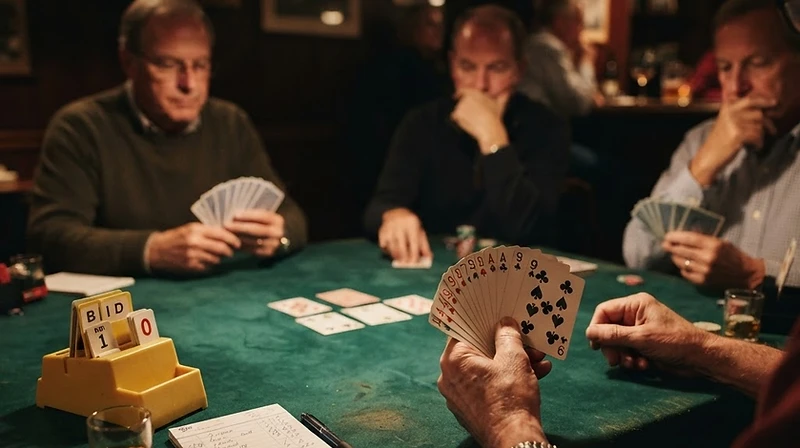
Bridge
Master the art of the silent conversation, where every bid is a promise and every trick holds a story.
But first, a little context and history...
Bridge is fundamentally a game of partnership and logical deduction played with a standard 52-card deck. Four players form two competing teams, sitting opposite their partners to navigate a two-phase process: the bidding auction and the play of the hand. While luck dictates the distribution of cards, victory relies entirely on memory, communication, and the strategic application of mathematical probabilities. It transforms a quiet room into a theater of intense mental engagement, making it an ideal discipline for those in their second prime who seek to sharpen their cognitive agility.
Its lineage traces back to Whist, a social staple of 17th-century Britain that introduced the foundational concept of trick-taking. By the late 19th century, the game evolved into Auction Bridge, which introduced the revolutionary concept of bidding to determine the trump suit. This shift moved the game away from pure chance toward calculated risk. Players could now signal their strength through verbal declarations, setting the stage for the sophisticated tactical language that defines the modern era.
In 1925, the American socialite and railroad heir Harold Vanderbilt spent a cruise ship journey refining these mechanics. He introduced the concept of 'vulnerability' and overhauled the scoring structure, creating what we now know as Contract Bridge. His rules demanded that players fulfill specific contract commitments to earn points, which sharply increased the reward for aggressive, accurate bidding. This standardization turned an informal parlor activity into a global phenomenon, fueled further by the legendary 1931 rivalry between titans Ely Culbertson and Sidney Lenz.
Today, the game thrives in both grand tournament halls and private living rooms. Duplicate Bridge remains the gold standard for competition, as it removes the variance of the cards by having different sets of players handle identical deals. This format highlights pure skill, allowing practitioners to measure their progress against established master point systems. Online platforms have also lowered the barrier to entry, offering casual players instant access to games across the globe without leaving their homes.
For the Gen X empty nester, Bridge offers a unique social and intellectual sanctuary. It requires only a deck of cards, a notepad for scoring, and an open mind. Unlike high-impact sports, it provides a low-stress environment that remains infinitely complex. Because it demands a partnership, it fosters a profound, non-verbal connection with a spouse or a friend. Each session acts as a mental workout that improves focus, pattern recognition, and long-term memory.
Getting started requires minimal investment beyond the price of a deck of cards and perhaps a introductory manual or a membership at a local bridge club. The initial learning curve focuses on the bidding systems—the shorthand language used to communicate hand strength to one's partner. Once the basic conventions are mastered, the real game begins: the defense, the sacrifice, and the finesse. It is a pursuit that matures along with the player, rewarding patience and perspective more than raw speed or agility.
In our hurried world, Bridge invites us to slow down and listen to what the cards are telling us. It demands presence. It asks us to consider our partner's perspective, to analyze the history of the current hand, and to project our strategy into the future. For those entering their second prime, it serves not just as a hobby, but as a community. It bridges the gap between solitary reflection and meaningful social connection, offering a lifelong challenge that is never fully conquered, yet always satisfying to explore.
“Bridge is a lifelong companion; it is a game that humbles you on Tuesday and teaches you to triumph by Friday.”
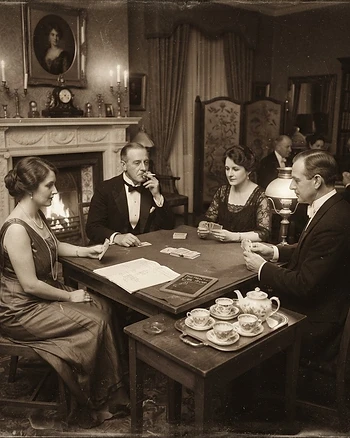
What to gather
A graded list of gear — from the first honest kit to the tools of a life in the craft. The Novice kit is free; the deeper tiers open with membership.
Novice
The first kit — enough to begin honestly.
From novice to proficient
A thirty-day passage. Each node is a day. The terracotta fill marks the ground you have already covered.
Understand the game: the deck, the four players, the partnership, the trick, the contract. Tour the table, the bidding, the play, the score. Today is orientation; the bridge begins tomorrow.
YouTubeThe Game and the Table
Learn Modern BridgeReflect on the partnership aspect of bridge; how does playing with a partner change your approach compared to solo card games?
Saved locally to your device


How the cohort practices today
The pulse is quiet — for now.
Be the first to document your Bridge journey with #EmptyNexxter.