
Bouldering
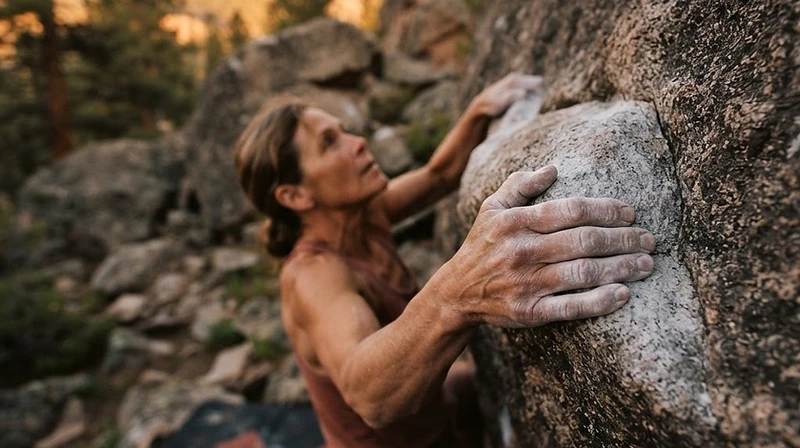
Ascend the stone with precision: a quiet, vertical dialogue between strength and mindfulness.
But first, a little context and history...
Bouldering is the art of climbing short, complex routes on natural rock or artificial walls without the encumbrance of ropes or harnesses. Instead of seeking a summit, the practitioner focuses on individual movements—often called 'moves'—to navigate a sequence of holds. It is a minimalist pursuit, requiring little more than specialized rubber-soled shoes, a bag of chalk for grip, and a foam pad to cushion the inevitable descent. For those in their second prime, it offers a perfect synthesis of physical conditioning and mental stimulation, turning the sheer face of a boulder into a personal, tangible puzzle.
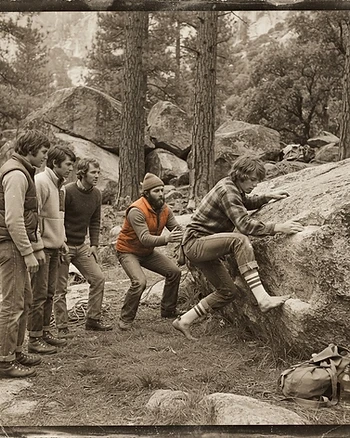
The activity traces its lineage to the Fontainebleau Forest near Paris in the late 1800s. Alpinists of the era utilized these erratic sandstone blocks to refine their technique during the off-season, preparing for larger mountaineering expeditions in the Alps. These early pioneers viewed the boulders as practice terrain, yet they soon realized that the technical difficulty of the rock far exceeded what they encountered on longer climbs. Over time, the forest became a sanctuary where style, grace, and localized mastery took precedence over the pursuit of peaks.
In the 1950s, American climber John Gill fundamentally shifted the discipline by applying gymnastic principles to the sport. A mathematician by trade, Gill introduced dynamic, fluid movement and the use of magnesium carbonate chalk to ensure a secure grip. He treated the boulder as a canvas for athletic expression, emphasizing power and aerial control. His influence moved bouldering away from being a mere training tool and established it as a legitimate sporting pursuit, shifting the focus toward the beauty of the movement itself.
By the 1990s, the sport underwent another significant evolution at Hueco Tanks in Texas. The introduction of the V-grade rating system by John 'Vermin' Sherman allowed climbers to measure and categorize the difficulty of specific routes, or 'problems.' This era transformed bouldering into a global community. It became a social experience where climbers gathered to support one another in solving challenging sequences. The explosion of indoor climbing gyms during this period further democratized the sport, providing controlled, safe environments for enthusiasts to train regardless of the weather.
For the Gen X empty nester, bouldering provides a unique tonic for the modern era. Unlike high-impact sports, it is self-paced and highly scalable. You choose the problem that fits your current strength level, and you possess the autonomy to stop whenever your muscles demand rest. It is a low-barrier, high-reward hobby that encourages deep focus, effectively silencing the noise of daily responsibilities. The practice demands complete presence, forcing one to ignore the external world in favor of the next handhold.
Getting started requires minimal investment beyond the essentials. A quality pair of climbing shoes should fit snugly to provide precision on small edges, while a chalk bag helps manage sweat during intensive sessions. A crash pad—a portable folding mattress—is standard equipment for safety when climbing outdoors. Most importantly, one must cultivate a mindset of persistence. Success in bouldering is rarely immediate; it is a repetitive process of failing, adjusting your grip, and refining your balance until the movement becomes fluid.
Today, bouldering is more accessible than ever, with state-of-the-art facilities offering routes designed for every ability level. It has grown from a niche alpine training method into a lifelong practice that emphasizes longevity, mobility, and community. Whether you are scaling a granite boulder in a quiet valley or navigating a colorful wall in a local gym, the core philosophy remains unchanged. You are there to solve the riddle of the stone, one thoughtful, deliberate movement at a time.
“Bouldering is a vertical chess game; it rewards patience and nuance far more than it rewards raw strength.”
What to gather
A graded list of gear — from the first honest kit to the tools of a life in the craft. The Novice kit is free; the deeper tiers open with membership.
Novice
The first kit — enough to begin honestly.
From novice to proficient
A thirty-day passage. Each node is a day. The terracotta fill marks the ground you have already covered.
Understand the craft: the problem, the pad, the move, the stance. Tour the shoe and the boulder. Today is orientation; the climb begins tomorrow.
YouTubeThe Craft and the Stone
Gravity LabReflect on the environment of the climbing gym; what aspects of the space feel most intimidating or welcoming to you as a beginner?
Saved locally to your device


How the cohort practices today
The pulse is quiet — for now.
Be the first to document your Bouldering journey with #EmptyNexxter.