
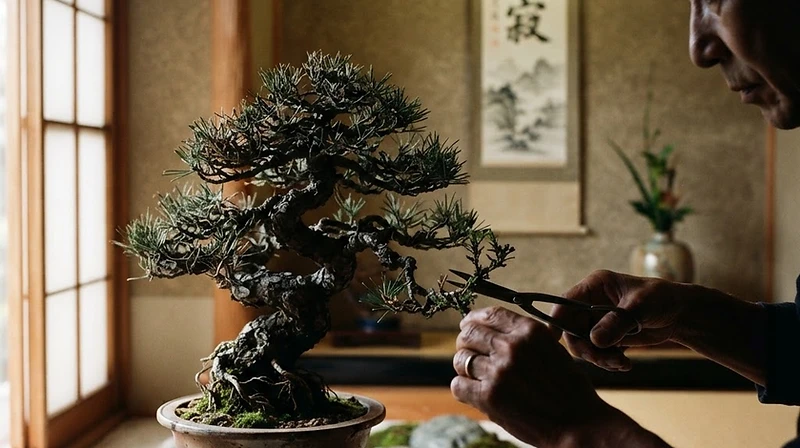
Bonsai
The art of a tree in a tray — a patience measured in decades and a tree that will outlive you.
But first, a little context and history...
Bonsai is the art of growing a tree in a tray, and it is older than most countries. The word is Japanese — bon, a tray, and sai, to plant — but the practice began in China, where the imperial court was cultivating miniature landscapes in shallow pots by the Tang dynasty, around 700 CE. The Chinese called it penjing — tray scenery — and the oldest surviving penjing, a five-needle pine in the collection of the Tokyo Imperial Palace, has been tended continuously since 1610, which means that a tree now standing in Japan was already a century old when the Pilgrims landed at Plymouth Rock.
The art crossed to Japan with the Buddhist monks who traveled to study in Tang China, and it was in Japan that penjing became bonsai — refined, codified, and joined to the Zen idea that the beauty of a thing is inseparable from its impermanence. The Japanese developed the styles that are still taught today: the formal upright, the informal upright, the slanting, the cascade, the semi-cascade, the literati, the windswept. Each style is a distillation of a tree's struggle with wind, water, and stone, reproduced in miniature and held in a pot no larger than a dinner plate. The oldest surviving bonsai photograph, a portrait of a Japanese black pine, dates to 1867; the first public bonsai exhibition was held in Tokyo in 1934.
The West met bonsai at the Paris Universal Exposition of 1878, where the Japanese pavilion displayed a collection that the French called arbres nains — dwarf trees — and that the English, with characteristic understatement, called a curiosity. The first bonsai club outside Japan was founded in London in 1960. The art came to America in the person of John Naka, a Japanese-American who was interned at Manzanar during the Second World War and who, after the war, became the first American to be admitted to the Nippon Bonsai Association. Naka's Goshin — a forest planting of eleven junipers, each representing one of his grandchildren — is now in the National Bonsai & Penjing Museum at the United States National Arboretum, alongside the tree that was given to the United States by Japan in 1976 as a bicentennial gift and that is still tended every day.
For the empty nester, bonsai is the rare hobby that is measured in decades rather than days. A bonsai is never finished; it is only paused. The tree you begin today will be tended by someone else after you are gone, and the knowledge that this is so is part of the art. Bonsai teaches patience, observation, and the acceptance of a timeline that is longer than a single life — which is, perhaps, the lesson the empty nest is already teaching you.
“A bonsai is never finished. It is only paused — and the pause is the art.”
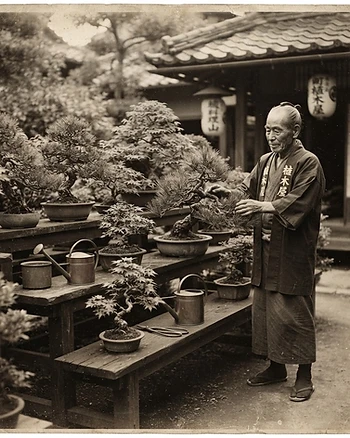
What to gather
A graded list of gear — from the first honest kit to the tools of a life in the craft. The Novice kit is free; the deeper tiers open with membership.
Novice
The first kit — enough to begin honestly.
Expert
The equipment of a life in the craft.
Coming soon
From novice to proficient
A thirty-day passage. Each node is a day. The terracotta fill marks the ground you have already covered.
Penjing, bonsai, sai-kei — the Chinese root, the Japanese refinement, the Vietnamese landscape. Know the lineage of the art you are entering.
YouTubeWhat Bonsai Is
Eisei-en BonsaiReflect on how the transition from Chinese penjing to Japanese bonsai changed the focus of the art form. How does knowing this history influence your perspective on the tree you are about to cultivate?
Saved locally to your device


How the cohort practices today
The pulse is quiet — for now.
Be the first to document your Bonsai journey with #EmptyNexxter.