
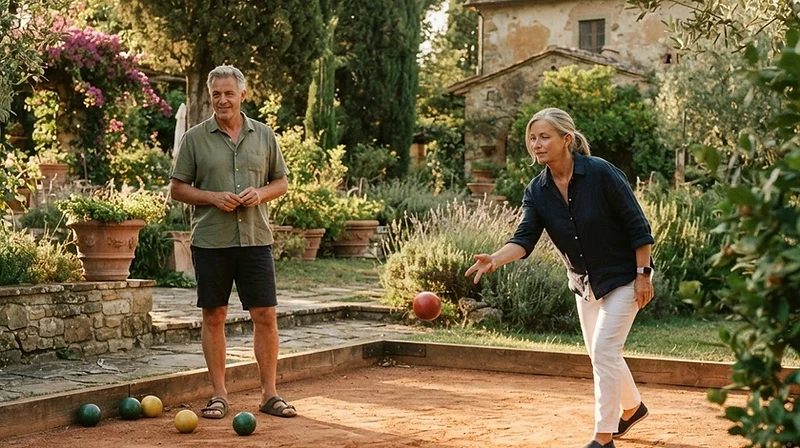
Bocce
The ancient art of rolling one ball closer than another — and arguing the measurement.
But first, a little context and history...
Bocce is among the oldest games humanity still plays. Its ancestor was tossed stones — the Egyptians threw rounded rocks toward a target as early as 5000 BCE, and a form of the game moved through ancient Greece into the Roman Empire, where soldiers bowled coconuts and then carved wooden balls toward a small leader stone called the pallino.
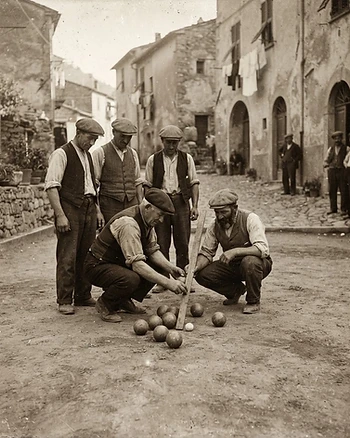
The name comes from the Vulgar Latin bottia, meaning a boss or knob, and the game hardened into its modern shape in the Italian peninsula. By the Middle Ages, bocce was so beloved — and so often wagered upon — that it drew the wrath of kings. In 1319, the Holy Roman Emperor Charles IV banned it for fear it distracted soldiers from archery practice. The Republic of Venice formally prohibited bocce in 1576, and the Catholic Church condemned it as a gateway to gambling. None of it worked; the game survived in piazzas and back lots from Liguria to Sicily.
Bocce crossed to the New World with Italian immigrants in the 19th and 20th centuries, taking root in the courtyards of San Francisco, the alleys of New York, and the Italian-American clubs of the Midwest. The modern standardized sport — governed internationally since 1946 by the Fédération Internationale de Boules — settled on a court roughly 90 feet long, four balls per side, and a pallino thrown first to set the target.
For the empty nester, bocce is the rare sport that improves with age: it rewards touch over power, reading the lie over strength, and a calm hand over a fast one. It is also one of the most social — a court is a place to stand, talk, and measure, in roughly that order.
“Bocce is not won with strength. It is won with the hand that can feel the court.”
What to gather
A graded list of gear — from the first honest kit to the tools of a life in the craft. The Novice kit is free; the deeper tiers open with membership.
Novice
The first kit — enough to begin honestly.
Advanced
The serious tools of a committed hand.
Coming soon
Expert
The equipment of a life in the craft.
Coming soon
From novice to proficient
A thirty-day passage. Each node is a day. The terracotta fill marks the ground you have already covered.
The court, the pallino, the eight balls, the frame — learn the shape of the game before you throw.
YouTubeThe Anatomy of a Bocce Court
Backyard LivingReflect on how the dimensions of a court might change your throwing strategy compared to playing on an open lawn.
Saved locally to your device


How the cohort practices today
The pulse is quiet — for now.
Be the first to document your Bocce journey with #EmptyNexxter.