
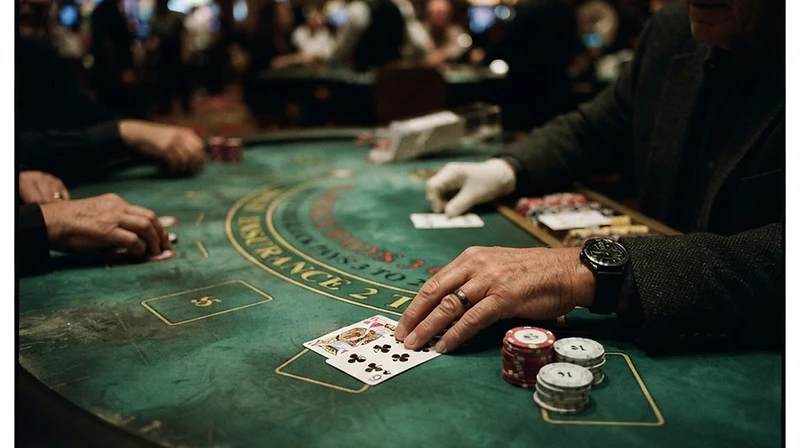
Blackjack
The hit, the stand, the count — a deck, a chart, and a bet, where the luck is in the cards and the edge is in the math.
But first, a little context and history...
Blackjack is the most studied game in the casino. You are dealt two cards, the dealer is dealt two, and the goal is to reach a total closer to 21 than the dealer without going over. The rules are simple enough to learn in five minutes. The depth is in the decisions — when to hit, when to stand, when to double, when to split — and in the fact that every card removed from the deck changes the odds for the remaining hands. This is what makes blackjack different from every other casino game: the past affects the future, and a player who tracks the past can gain an edge over the house.
The game's ancestry runs through two European card games. The first written record comes from Miguel de Cervantes, who in the early 17th century described a Spanish game called ventiuna — twenty-one — played with a baraja, the Spanish deck. His novella "Rinconete y Cortadillo" features two card cheats who are skilled at ventiuna, which tells us the game was already old and already attracting sharp players. The second ancestor is the French vingt-et-un, played in the royal court in the 18th century and brought to America by French colonists. The game appeared in American gambling houses in the 19th century, but it was not especially popular. To draw players, casinos offered a bonus payout for a hand containing an ace of spades and a black jack — and that bonus gave the game its name.
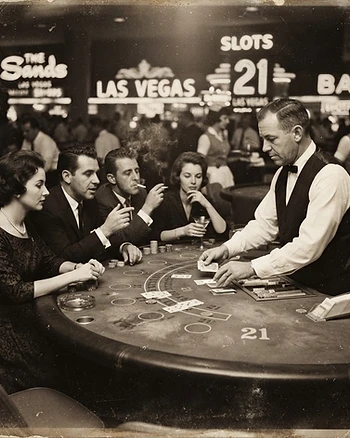
Blackjack's modern life began in 1931, when Nevada legalized casino gambling and Las Vegas became its capital. The game was a staple of every casino floor, but it was considered a game of pure luck. That changed in 1956, when a group of four mathematicians at the Army's Aberdeen Proving Ground published a paper called "The Optimum Strategy in Blackjack" in the Journal of the American Statistical Association. They proved, for the first time, that a mathematically optimal way to play every hand existed. Edward Thorp, an MIT mathematician, took their work further. In 1962 he published "Beat the Dealer," which introduced basic strategy — the complete chart of every correct decision for every hand against every dealer upcard — and proved that a player who followed it could reduce the house edge to roughly half a percent. The book was a sensation. It sold 700,000 copies, and casinos briefly changed their rules in panic before realizing that most players would not bother to learn the chart.
Thorp also introduced card counting — the practice of tracking the ratio of high cards to low cards remaining in the deck and raising your bet when the deck was favorable. Because blackjack is a dependent-trial game (cards removed from the deck are gone until the shuffle), a deck rich in tens and aces favors the player: the dealer is more likely to bust, blackjack is more likely, and the player can bet more. The Hi-Lo system, the KO system, and the Zen Count are all variations on this idea. Counting does not require a photographic memory; it requires the ability to add and subtract by ones and keep a running total in your head while appearing to play casually.
The most famous practitioners of card counting were the MIT Blackjack Team, a group of students and alumni from MIT, Harvard, and other Boston-area schools who, from 1979 through the early 2000s, used team play and card counting to win tens of millions from casinos worldwide. Their story was told in Ben Mezrich's book "Bringing Down the House" and the film "21." The casinos responded with countermeasures: more frequent shuffles, multi-deck shoes, facial recognition databases, and the right to ban suspected counters. Counting is not illegal, but casinos are private property and can ask anyone to leave.
The equipment is minimal. A deck of cards (or six, in a casino shoe), a basic strategy chart you can print on a wallet card, and a bankroll you are willing to lose. The skill is in memorizing the chart, learning to count, and — hardest of all — maintaining discipline. The chart is not a secret; it is available free online and in every blackjack book. What separates the casual player from the advantage player is the willingness to play the chart perfectly, every hand, even when it feels wrong, and the discipline to bet more when the count is high and less when it is low.
For the empty nester, blackjack is a hobby that rewards a careful mind. It does not demand youth, strength, or speed. It demands patience, arithmetic, and nerve. The first session is a loss you can feel. The hundredth is a session where the chart is automatic and the count is running and you are playing with an edge the house does not know you have. The deck does not care how old you are. It only cares how well you can count.
“The house has the odds. The chart has the answer. The count has the edge. The rest is nerve.”
What to gather
A graded list of gear — from the first honest kit to the tools of a life in the craft. The Novice kit is free; the deeper tiers open with membership.
Novice
The first kit — enough to begin honestly.
From novice to proficient
A thirty-day passage. Each node is a day. The terracotta fill marks the ground you have already covered.
Understand the game: the deck, the cards, the dealer, the 21, the bust. Tour the table, the shoe, the chip, the payout. Today is orientation; the blackjack begins tomorrow.
YouTubeThe Game and the Table
Blackjack ApprenticeshipReflect on the flow of a standard blackjack round. How does the dealer's role differ from the player's role in terms of decision-making?
Saved locally to your device


How the cohort practices today
The pulse is quiet — for now.
Be the first to document your Blackjack journey with #EmptyNexxter.