
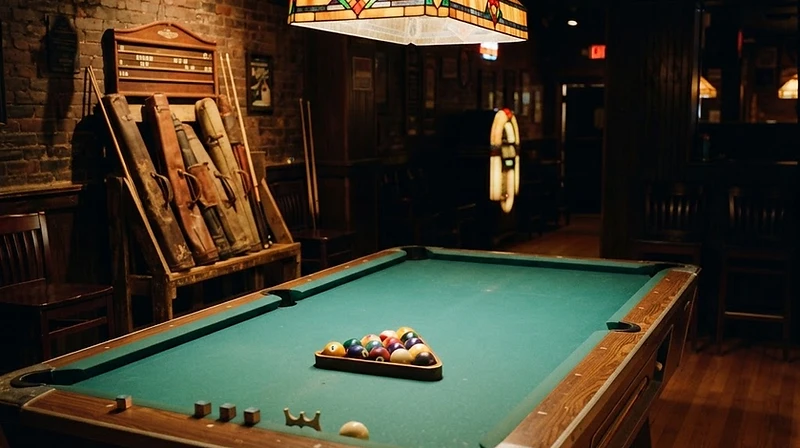
Billiards
A game of geometry, touch, and nerve played on green felt since the 15th century — the table is a canvas, the cue is a brush, and every shot is a small negotiation with physics.
But first, a little context and history...
Billiards began on the ground. The game evolved from a lawn game played in 15th-century Northern Europe — something like croquet, where a ball was pushed through a wicket with a mace. When the weather turned, the game moved indoors onto a table covered in green cloth to simulate the grass, and a raised wooden rail kept the balls from rolling off. By the 1470s, billiards was documented in the accounts of Louis XI of France, and within a century it had spread through the courts of Europe. Louis XIV played. Mary Queen of Scots was so devoted to the game that when she was imprisoned and executed in 1587, her body was wrapped in her billiard cloth — the only possession she was allowed to keep to the end.
The equipment evolved slowly and deliberately. The mace gave way to the cue stick — the word comes from the French queue, meaning tail — in the late 18th century, when players found that using the narrow end of the mace allowed more delicate control. The tip was leather at first, then leather replaced by chalked leather, and finally the leather tip was glued and shaped to hold chalk, allowing the player to impart spin — English, as Americans call it, or side, as the British say. The balls were ivory until the 1860s, when a $10,000 prize for a synthetic substitute produced celluloid, the first plastic. The slate bed replaced wood in the early 19th century, giving the table the dead-flat surface the game demands. The green cloth became the standard, and the pockets — originally just hazards cut into the rail — became the targets.
The game split into families. Carom billiards, played on a pocketless table with three balls, is the Continental tradition — the art of the cannon, the rail nurse, and the three-cushion shot. Pool, played on a table with six pockets, is the American and British pub tradition — eight ball, nine ball, straight pool, and one-pocket, each with its own culture and its own champions. Snooker, invented by British army officers in India in 1875, is played on a larger table with smaller pockets and twenty-two balls, and it became the dominant cue sport of the British Commonwealth. Each discipline is a different conversation with the same physics: angle, speed, spin, and the uncontrollable variable of the cloth.
What makes billiards endure is that it is a game of pure execution. There is no opponent touching your shot, no dice, no card to draw. The table is set, the angle is there, and either you make the ball or you do not. The empty nester finds in billiards what every player has found since the 15th century: a game that is meditative and competitive at once, that rewards practice with visible improvement, and that can be played alone against the table for a lifetime. The cue is a simple stick of wood, but it is the most precise instrument most people will ever hold, and the green felt is a surface where geometry becomes a feeling in the hands.
“The table is set, the angle is there, and either you make the ball or you do not — billiards is a game of pure execution.”
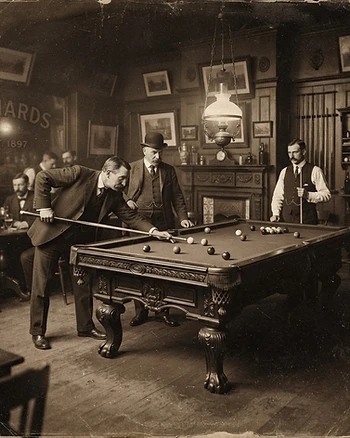
What to gather
A graded list of gear — from the first honest kit to the tools of a life in the craft. The Novice kit is free; the deeper tiers open with membership.
Novice
The first kit — enough to begin honestly.
From novice to proficient
A thirty-day passage. Each node is a day. The terracotta fill marks the ground you have already covered.
Establishing a stable foundation and a relaxed, consistent grip on the cue.
YouTubeThe Stance and Grip
Venom TrickshotsHow does your body feel when you are perfectly aligned with the shot?
Saved locally to your device


How the cohort practices today
The pulse is quiet — for now.
Be the first to document your Billiards journey with #EmptyNexxter.