
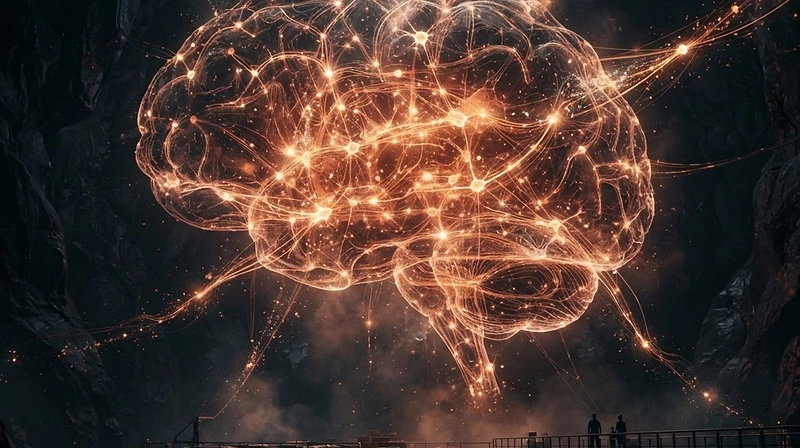
Basic Understanding of Artificial Intelligence
From the Dartmouth Conference to ChatGPT — a grounded passage through the field that is reshaping everyday life.
But first, a little context and history...
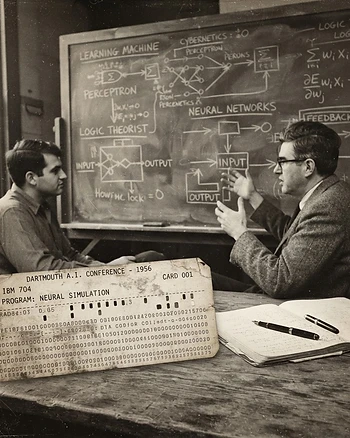
The dream of artificial intelligence is far older than the machines that could attempt it. Ancient myths and philosophy grappled with the idea of artificial beings — from Talos, the bronze guardian of Crete in Greek mythology, to the golems of Jewish folklore and the mechanical turks of the Enlightenment. But the field as we know it was born in the summer of 1956, at the Dartmouth Summer Research Project on Artificial Intelligence.
Organized by John McCarthy, Marvin Minsky, Nathaniel Rochester, and Claude Shannon, the Dartmouth Conference gathered the pioneers who believed that 'every aspect of learning or any other feature of intelligence can in principle be so precisely described that a machine can be made to simulate it.' The term 'artificial intelligence' itself was coined at this gathering. The optimism was extraordinary: researchers predicted that within a generation, machines would match human intelligence across all domains.
The early decades produced remarkable results. Arthur Samuel's checkers-playing program (1959) learned to beat its own creator. Joseph Weizenbaum's ELIZA (1966) simulated a Rogerian psychotherapist well enough that some users formed emotional attachments to it. But the limitations of brute-force approaches soon became clear, and the field entered the first 'AI winter' in the 1970s as funding dried up and promised breakthroughs failed to materialize.
The field revived in the 1980s with expert systems — programs that encoded human knowledge in rule-based form. Companies invested heavily, but these systems were brittle, expensive, and unable to handle the messiness of real-world ambiguity. A second AI winter followed in the late 1980s.
The modern era of AI was built on a different foundation: statistical learning from data rather than hand-coded rules. The turning point came in 2012, when a deep neural network called AlexNet, trained on graphics processing units (GPUs), dominated the ImageNet visual recognition competition. Deep learning — neural networks with many layers — proved that machines could learn to perceive the world by finding patterns in vast datasets.
The decade that followed saw cascading breakthroughs. Machines learned to play Go (DeepMind's AlphaGo, 2016), translate languages (Google Neural Machine Translation), generate images (DALL-E, Stable Diffusion), and write code. The release of large language models — GPT-3 in 2020, ChatGPT in 2022 — brought AI into daily life for hundreds of millions of people. A technology that had spent decades in research labs became a consumer product almost overnight.
Understanding artificial intelligence today means understanding a field shaped by cycles of hype and humility, where the gap between what machines can do and what they can explain about how they do it remains one of the deepest open questions in computer science.
“Intelligence is not a thing a machine has. It is a thing a machine does — and we are only beginning to understand the difference.”
What to gather
A graded list of gear — from the first honest kit to the tools of a life in the craft. The Novice kit is free; the deeper tiers open with membership.
Novice
The first kit — enough to begin honestly.
From novice to proficient
A thirty-day passage. Each node is a day. The terracotta fill marks the ground you have already covered.
Explore the origins of AI and the vision of the pioneers who believed machines could simulate human intelligence.
YouTubeThe Birth of AI: Dartmouth 1956
Dr. Raj RameshWhat was the core conjecture of the Dartmouth workshop participants?
Saved locally to your device


How the cohort practices today
The pulse is quiet — for now.
Be the first to document your Basic Understanding of Artificial Intelligence journey with #EmptyNexxter.