

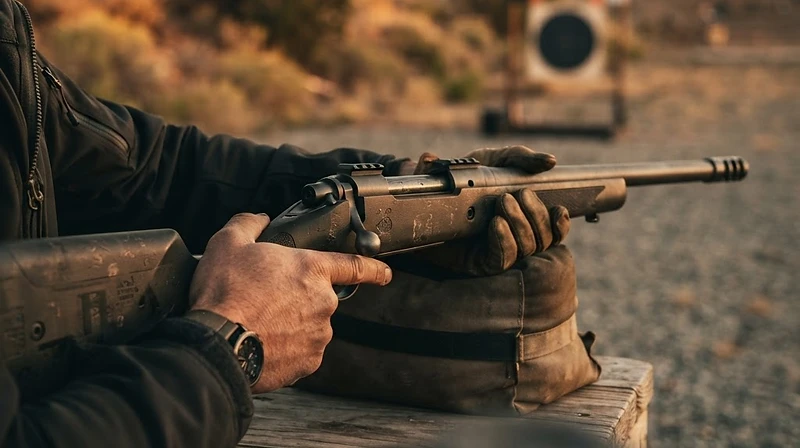
Basic Marksmanship
From the longbow to the precision rifle — the timeless fundamentals of putting one shot exactly where you intend.
But first, a little context and history...
The discipline of marksmanship is as old as ranged weapons themselves. The first archers who learned to account for wind, distance, and the flight time of an arrow were practicing the same fundamentals a modern shooter uses: sight alignment, breath control, trigger discipline, and follow-through. What changed was the tool.
The sling and the bow were humanity's first precision instruments. By the time of the English longbowmen at Agincourt (1415), marksmanship was a trained, national skill — English law required weekly archery practice. The crossbow and early firearms gradually displaced the bow, but the fundamental marksmanship principles remained.
The true revolution in marksmanship came with the rifled barrel. Grooves cut into the bore imparted spin to the projectile, dramatically improving accuracy and range. Rifles appeared in Europe by the 16th century, but they were slow to load and remained specialty weapons until the 19th century. The Kentucky long rifle, carried by American frontiersmen, became a symbol of self-reliant marksmanship in the New World.
The American Revolution demonstrated the tactical value of individual marksmanship. Morgan's Riflemen, a unit of frontier sharpshooters, used their superior accuracy to harass British officers and artillery crews at ranges that smoothbore muskets could not match. The tradition of the American marksman was born.
The Civil War saw the first widespread use of rifled muskets and the introduction of sharpshooter units. Colonel Hiram Berdan's 1st United States Sharpshooters, selected through marksmanship trials, became one of the war's most elite units. The conflict also produced the first telescopic rifle sights in widespread military use.
The late 19th and early 20th centuries transformed marksmanship from a military necessity into a civilian sport. The National Rifle Association, founded in 1871 to promote marksmanship training, established competitive shooting programs. The 1903 establishment of the Civilian Marksmanship Program formalized the government's role in fostering shooting skill among the public. Olympic shooting events debuted at the 1896 Athens Games.
The two World Wars reinforced the importance of individual rifle proficiency. The 'every man a marksman' ethos drove training reforms, and the bolt-action service rifle became the standard against which marksmanship was measured. The M1903 Springfield, the Lee-Enfield, and the Mauser 98 defined an era of precision infantry shooting.
The modern era of marksmanship is defined by the precision bolt-action rifle, the telescopic sight, and the science of ballistics. Competitive disciplines — High Power, F-Class, Precision Rifle Series, and Olympic three-position — push the boundaries of what a human behind a rifle can achieve. The fundamentals, though, have not changed in a thousand years: a steady position, a clear sight picture, a controlled trigger press, and a calm mind.
“Marksmanship is not about the rifle. It is about the stillness between the shooter and the shot.”
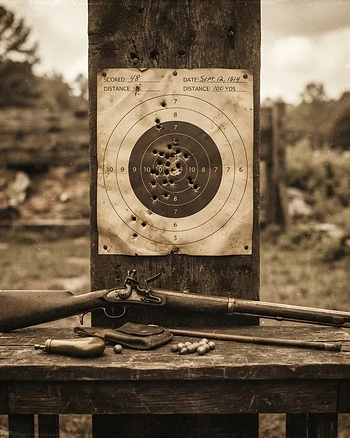
What to gather
A graded list of gear — from the first honest kit to the tools of a life in the craft. The Novice kit is free; the deeper tiers open with membership.
Novice
The first kit — enough to begin honestly.
From novice to proficient
A thirty-day passage. Each node is a day. The terracotta fill marks the ground you have already covered.
Introduction to the core concepts of stance, grip, sight alignment, and trigger press.
YouTubeThe Four Pillars of Marksmanship
3 of 7 ProjectWhich of the four pillars feels most natural to you, and which requires the most conscious effort?
Saved locally to your device
Advanced Marksmanship Techniques
Once the fundamentals are second nature — steady position, sight alignment, trigger control, and follow-through — the real discipline begins. These techniques build directly on the 30-day lab and open the door to consistent accuracy at distance and under field conditions.
Reading Wind & Mirage
Wind is the single greatest variable at distance. Learn to read mirage through your scope, estimate wind value from flags and vegetation, and apply holds or dial windage with confidence.
- •Estimate wind speed from mirage intensity (boiling = ~8 mph, gentle = ~3 mph)
- •Use the clock-face method to apply a cosine to your wind value
- •Dial or hold for wind in consistent increments rather than guessing
Ballistics & Drop Compensation
Beyond 300 yards, gravity and velocity loss demand real ballistics work. Understand your rifle's trajectory, build a drop chart, and translate it into scope dialing or reticle holds.
- •Chronograph your load to establish true muzzle velocity
- •Build a drop chart in 50-yard increments out to your maximum range
- •Practice dialing elevation in mils or MOA from a known zero
Positional & Improvised Shooting
Real shooting rarely happens from a bench. Master the prone, kneeling, seated, and standing positions, and learn to build stable improvised supports from packs, terrain, and slings.
- •Use a sling to lock in a steady prone or sitting position
- •Build a stable tripod or pack-supported position when prone is not possible
- •Practice natural point of aim — let the position aim the rifle, not your muscles
Calling Your Shots & Group Diagnosis
The advanced shooter knows where the shot went the instant it broke. Learn to call your shots from the sight picture at recoil, and diagnose group patterns to correct technique, not just point of impact.
- •Read the wobble of the crosshairs at the moment of trigger break
- •Diagnose vertical stringing (breathing) vs. horizontal scatter (trigger or wind)
- •Track shot-call accuracy in your notebook to build self-awareness
The Path Forward
These techniques are the bridge from the 30-day lab into a lifetime of refinement. Pair them with the advanced and expert gear in the Gear Guide, and consider an Appleseed clinic or a precision rifle match to test your progress under the eye of experienced shooters.


How the cohort practices today
The pulse is quiet — for now.
Be the first to document your Basic Marksmanship journey with #EmptyNexxter.