
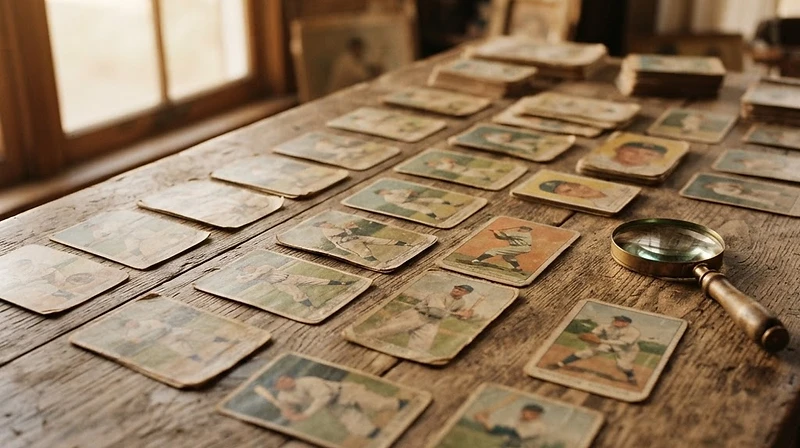
Baseball Card Collecting
A pocket-sized archive of the national pastime — where a child's bubblegum premium became a century-long pursuit of condition, rarity, and the stories cardboard can carry.
But first, a little context and history...
The baseball card was born before the professional league. In the 1860s, sporting-goods firms and tobacco companies printed trade cards to stiffen cigarette packs and advertise their wares, and a ballplayer's face was cheaper than a full illustration. The first set widely collected — the 1887 Old Judge cigarettes — carried sepia portraits of players in their street clothes, and a boy who wanted one had to buy a man's tobacco.
What turned a premium into a hobby was the bubblegum. In 1933, Goudey Gum Company issued a 240-card set with a stick of gum and a color lithograph of Babe Ruth, and a generation of children learned to flip, trade, and bicycle-clip their cards onto spokes. The modern era began in 1951, when Topps — a gum company that would become the hobby's dictionary — issued its first baseball set, and the rookie card, the numbered series, and the back-of-card statistics became the grammar every collector would learn.
What makes the hobby singular is that it is an archive measured in condition. A 1952 Topps Mickey Mantle is worth a quarter of a million dollars in mint and a few thousand in excellent — the difference is a corner's sharpness, a centering's margin, a surface's gloss, graded on a ten-point scale by a third party and sealed in plastic. The collector learns to see what the eye cannot: a print dot, a wax stain, a factory line. And beneath the grading lies the older pleasure — the card as a record of a season, a career, a team's year, held in the hand and read like a page.
“A card is not paper; it is a frozen afternoon — the rookie before the record, the uniform before the trade, a sliver of the game preserved in cardboard and time.”

What to gather
A graded list of gear — from the first honest kit to the tools of a life in the craft. The Novice kit is free; the deeper tiers open with membership.
Novice
The first kit — enough to begin honestly.
From novice to proficient
A thirty-day passage. Each node is a day. The terracotta fill marks the ground you have already covered.
Explore the origins of baseball cards from 19th-century tobacco premiums to the modern era.
YouTubeThe History of Baseball Cards
Sports Cards EDGEWhat surprised you most about the evolution of the baseball card?
Saved locally to your device


How the cohort practices today
The pulse is quiet — for now.
Be the first to document your Baseball Card Collecting journey with #EmptyNexxter.