

Ballroom Dancing
A synchronized dialogue in movement, where the music guides the frame and the floor becomes a sanctuary.
But first, a little context and history...
Ballroom dancing is fundamentally an exercise in trust and spatial awareness. It requires two participants to act as a single unit, navigating a shared floor through a system of non-verbal cues known as leading and following. While modern social dancing emphasizes relaxation, its roots lie in the rigid etiquette of the European aristocracy. Long before it became a weekend pastime, the ballroom was a high-stakes arena of social mobility and displays of grace, where the Minuet and Quadrille dictated the movements of the elite. Over centuries, these formal court rituals shed their stiffness, evolving into the fluid, expressive styles we recognize today.
The early 20th century served as a pivotal turning point for the craft. In 1912, the formalization of the Viennese Waltz brought a new sense of urgency and circular motion to the dance floor. This era marked a transition from disjointed, regional styles toward a unified technical standard. Figures like Vernon and Irene Castle capitalized on this movement, popularizing a more natural, flowing approach to ballroom that moved away from heavy, upright posturing. By standardizing the 'box step' and the rotational mechanics of the waltz, instructors of the 1910s provided a template that remains the foundational bedrock for every beginner who steps onto a polished hardwood floor today.
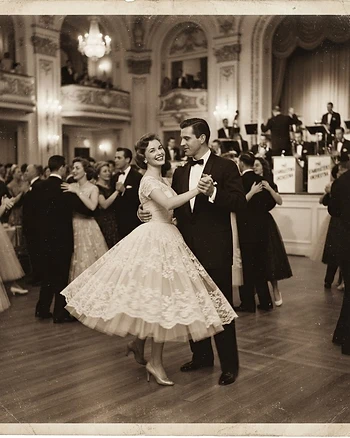
Following the structural shifts of the 1910s, the mid-20th century ushered in the Golden Age of ballroom. During the 1940s and 1950s, the rise of big bands and grand hotel ballrooms turned social dancing into a cultural phenomenon. It was an era defined by the elegance of the orchestra, the crispness of a tuxedo, and the fluid grace of floor-length gowns. This period cemented ballroom's status as a quintessential communal event, moving it from the exclusive domain of the aristocracy into the community centers and dance halls of the middle class, where it flourished as a primary mode of courtship and recreation.
For the Gen X empty nester, ballroom dancing offers more than just a trip down memory lane; it provides a sophisticated physical outlet that is both meditative and invigorating. As children leave home and schedules shift, the ballroom offers a structured environment to reconnect with one's physical self. The mental engagement required to master complex footwork patterns acts as a powerful cognitive exercise, while the sustained movement improves cardiovascular health and posture. There is a distinct, quiet satisfaction in finally mastering the mechanics of a turn or the tension required for a proper lead, providing a sense of accomplishment that is rare in modern, fast-paced digital life.
Practicing ballroom today requires little beyond a commitment to learning and a pair of supportive, slick-soled shoes. While specialized suede-bottomed footwear is recommended to prevent injury and allow for easy pivoting, the most vital piece of equipment is the frame itself. The frame refers to the posture and tension maintained between partners, ensuring that signals are transmitted clearly through the arms and shoulders. Modern dance studios offer a welcoming, low-pressure environment for adults to study these mechanics, focusing on the interplay of rhythm and proximity rather than the rigid competition standards of the past.
Ultimately, ballroom is an enduring craft because it addresses a fundamental human desire for connection. In a world where interaction is often mediated through screens, the ballroom demands presence. It asks you to look your partner in the eye, match your breath to theirs, and respond to the cadence of a melody in real-time. Whether you are revisiting the classic elegance of the waltz or experimenting with the sharp, syncopated rhythms of the cha-cha, the dance floor remains a place where time slows down. It is a hobby that respects the maturity of its practitioners, offering a lifelong pursuit that rewards patience, grace, and the simple joy of moving in harmony with another.
“Dancing is a conversation between two people where the music provides the vocabulary and the embrace serves as the grammar.”
What to gather
A graded list of gear — from the first honest kit to the tools of a life in the craft. The Novice kit is free; the deeper tiers open with membership.
Novice
The first kit — enough to begin honestly.
Expert
The equipment of a life in the craft.
Coming soon
From novice to proficient
A thirty-day passage. Each node is a day. The terracotta fill marks the ground you have already covered.
Understand the craft: the frame, the lead, the step, the count. Tour the gear and the hall. Today is orientation; the dance begins tomorrow.
YouTubeThe Craft and the Floor
Ballroom FeedReflect on the environment of the dance floor and how the basic elements introduced today set the stage for your movement. What aspect of the 'frame' or 'count' feels most natural to you so far?
Saved locally to your device


How the cohort practices today
The pulse is quiet — for now.
Be the first to document your Ballroom Dancing journey with #EmptyNexxter.