
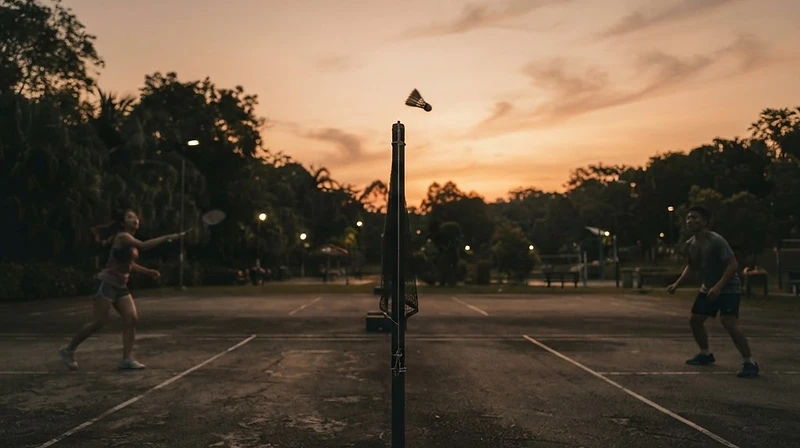
Badminton
The fastest racket sport on earth: a dance of reflexes, deception, and the feathered shuttle's slow, telling arc.
But first, a little context and history...
Badminton is a game of paradox. The shuttlecock, a fragile cone of sixteen feathers, drifts with an almost meditative slowness through the air — and then, struck cleanly, accelerates faster than any other projectile in racket sport. It is this duality that defines the game: patience married to explosive reflex, geometry disguised as instinct.
The court is small, the net is high, and the angles are ruthless. Where tennis rewards power, badminton rewards placement; where squash demands endurance, badminton demands deception. A drop shot that seems to float can die an inch past the net; a smash can leave the strings at over two hundred miles per hour. The same wrist that coaxes a delicate net kill can, a stroke later, unleash the steepest attack in the sport.
For the empty nester, badminton offers something rare among racket sports: a low barrier to genuine play and a ceiling that recedes for as long as you care to chase it. The basic stroke is learned in an afternoon; the subtlety of the net game absorbs a lifetime. It is also one of the most social of sports — played in pairs across a net, in backyards and church halls as readily as in arenas, and it scales gracefully with age. The shuttle's drag means the body need not absorb the pounding of a tennis ball; the rallies, though, will find your lungs.
To take up badminton is to learn to read an opponent's wrist, to disguise intention in the pause before a shot, and to trust the slow arc of the feather. It is a game that begins as gentle exercise and reveals itself, slowly, as one of the most technically demanding sports ever played with a racket.
“The shuttle floats like a thought and falls like a verdict; the whole game is learning which is which.”
What to gather
A graded list of gear — from the first honest kit to the tools of a life in the craft. The Novice kit is free; the deeper tiers open with membership.
Novice
The first kit — enough to begin honestly.
From novice to proficient
A thirty-day passage. Each node is a day. The terracotta fill marks the ground you have already covered.
Learn the fundamental forehand and backhand grips to ensure proper racket control.
YouTubeMastering the Racket Grip
BasicfeatherHow does changing your grip feel when transitioning between forehand and backhand swings?
Saved locally to your device


How the cohort practices today
The pulse is quiet — for now.
Be the first to document your Badminton journey with #EmptyNexxter.