

Backgammon
The oldest game you can still play — five thousand years of dice, strategy, and the oldest argument in gaming: skill versus luck.
But first, a little context and history...
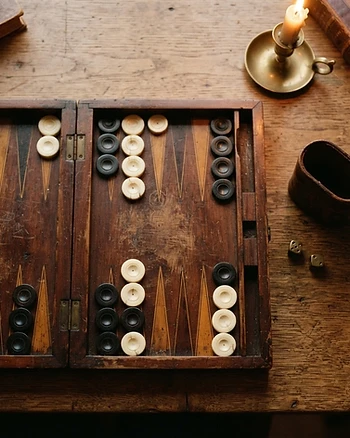
Backgammon is a race game for two players. Each player has fifteen checkers that move around a board of twenty-four triangular points, driven by the roll of two dice. The checkers move in opposite directions, and the first player to bear off all fifteen wins. The board is a track — a path that loops from one side to the other — and the game is a race. But it is a race with contact: your checkers can be hit and sent back to the start, and you can block your opponent's checkers with your own. The dice give you your moves, but where you put the checkers is the game.
Backgammon is the oldest board game still played today. The oldest known ancestor is the Royal Game of Ur, discovered by the archaeologist Leonard Woolley in the 1920s in the Royal Cemetery of Ur, in what is now southern Iraq. The game dates to approximately 2600 BCE — nearly five thousand years ago — and the board, the pieces, and the dice were found intact in the grave of a Sumerian nobleman. The Royal Game of Ur was a race game: two players moved pieces around a board of twenty squares, driven by the roll of tetrahedral dice. The rules were lost for four thousand years until a cuneiform tablet, translated in the 2010s by Irving Finkel of the British Museum, revealed how the game was played — and it was unmistakably the ancestor of backgammon.
The game traveled. The Romans played a version called ludus duodecim scriptorum — the game of twelve lines — on boards scratched into the stone of every Roman garrison from Britain to Syria. The tabula, a closer ancestor with fifteen checkers and two dice, was the game the Emperor Claudius was said to have played so obsessively that he had a board fitted to his chariot so he could play while traveling. The game reached Persia as nard, and the Persian version — with its board of twenty-four points, its movement in opposite directions, and its use of two dice — is the direct ancestor of the game we play today.
The modern game took shape in Europe in the Middle Ages. The name backgammon first appears in English in the 17th century, and the game was a favorite of the English gentry — played in coffee houses and clubs, and often for stakes. The doubling cube — the single innovation that distinguishes modern backgammon from its ancient ancestors — was introduced in the 1920s in the gambling clubs of New York. The doubling cube transformed backgammon from a parlor game into a gambling game: at any point, a player could double the stakes, and the opponent had to accept the double or concede the game at the current stakes. This single innovation turned backgammon into a game of judgment as well as dice — knowing when to double and when to drop is the skill that separates the master from the amateur.
The 1970s were the golden age of backgammon. Prince Alexis Obolensky, a Russian emigre, organized the World Backgammon Championship in Las Vegas in 1964, and the tournament became an annual event that drew celebrities, aristocrats, and professional gamblers. The game was the darling of the disco era — played in the back rooms of Studio 54, in the clubs of London, and on the yachts of the Mediterranean. The boom ended with the rise of poker in the 2000s, but backgammon never disappeared: it remained the game of the European intellectual, the Turkish cafe, the Iranian household, and the serious gambler who understood that backgammon, played well, is the deepest dice game ever invented.
The modern game is played in two forms. Money backgammon — where each game is played for a stake, and the doubling cube is in play — is the form preferred by serious players. Match backgammon — where a series of games is played to a target score — is the tournament form. Both forms use the same rules, but the strategy differs: in money play, you play for the expected value of each position; in match play, you play for the score, and the score changes the correct play.
For the empty nester, backgammon is a game that rewards a lifetime of play. The dice are random, but the decisions are not: a good player wins 60 to 65 percent of games against an average player, and the gap widens with experience. The first day is learning the race — how to move the checkers, how to hit, how to make points. The hundredth day is learning the cube — when to double, when to drop, and when to play on — and the cube is where the real game lives.
“A good player wins sixty percent of the time. The dice are random. The decisions are not.”
What to gather
A graded list of gear — from the first honest kit to the tools of a life in the craft. The Novice kit is free; the deeper tiers open with membership.
Novice
The first kit — enough to begin honestly.
From novice to proficient
A thirty-day passage. Each node is a day. The terracotta fill marks the ground you have already covered.
Understanding the board layout, the 24 points, and the correct starting position for all 30 checkers.
YouTubeThe Board and Setup
thenewbostonDraw the starting board layout from memory. What is the most confusing part of the setup?
Saved locally to your device


How the cohort practices today
The pulse is quiet — for now.
Be the first to document your Backgammon journey with #EmptyNexxter.