
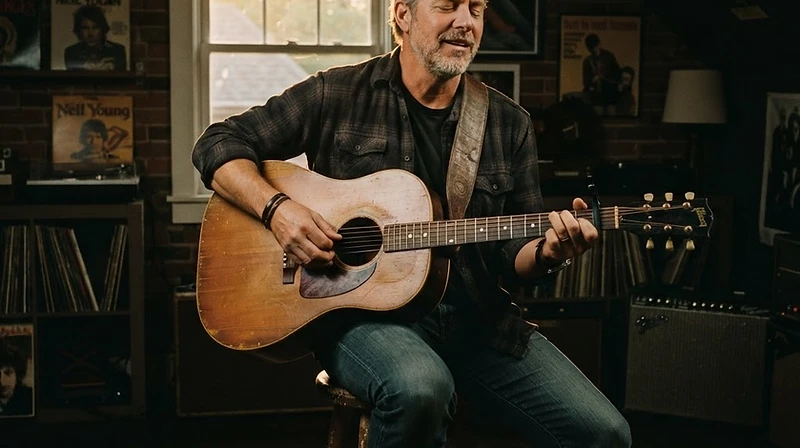
Acoustic Guitar
The instrument of the American porch — complete on its own, with two hands and a song.
But first, a little context and history...
The acoustic guitar is the instrument of the American living room, and it is younger than the piano. The guitar's ancestors — the lute, the vihuela, the baroque guitar — were court instruments in Renaissance Europe, played from tablature and tuned in courses of paired strings. The modern acoustic guitar, with six single strings and a flat top, emerged in Spain in the late eighteenth century; Antonio de Torres Jurado, working in Seville in the 1850s, gave the classical guitar its present shape, its fan bracing, and its proportions, and every classical and flamenco guitar since is a descendant of his design.
The steel-string acoustic guitar is an American invention, and it was born of a different need. The classical guitar was built for the parlor; the American guitar was built for the porch and the dance. In the 1850s, German immigrants in Pennsylvania and New York began building guitars with steel strings, which are louder than gut but exert far more tension on the top. The X-bracing pattern that let a flat top withstand that tension was patented by C. F. Martin & Company in 1843, and the Martin dreadnought — named after a class of British battleship and larger than any guitar before it — was introduced in 1916 and became the defining shape of the American acoustic guitar. The dreadnought was built to be heard over a band, and it was the instrument that made the guitar a lead voice rather than an accompaniment.
The twentieth century turned the acoustic guitar into the instrument of folk, country, and blues. The Carter Family, recording from 1927, used the autoharp and the guitar to hold down the rhythm and the harmony of a song at once, and Maybelle Carter's 'Wildwood Flower' invented the Carter scratch — the melody-picked bass line under a strummed chord — that every folk guitarist has learned since. The blues guitarists of the Mississippi Delta — Charley Patton, Son House, Robert Johnson — played steel-string acoustics with a slide or a bottleneck and turned the instrument into a solo voice, a drum, and a choir at once. The folk revival of the 1950s and 1960s put an acoustic guitar in the hands of every college student in America; the instrument that had been the sound of the porch became the sound of the protest, the coffeehouse, and the campfire.
For the empty nester, the acoustic guitar is the rare instrument that is complete on its own. A piano needs a room; a violin needs a quartet; a guitar needs only two hands and a song. It is the instrument that lets one person hold a melody, a harmony, and a rhythm at once, and the one that has accompanied more American evenings than any other. The guitar you buy today will be the guitar someone plays after you are gone, and the first chord you learn is the first chord of every song you will ever sing.
“A piano needs a room. A violin needs a quartet. A guitar needs only two hands and a song.”

What to gather
A graded list of gear — from the first honest kit to the tools of a life in the craft. The Novice kit is free; the deeper tiers open with membership.
Novice
The first kit — enough to begin honestly.
Expert
The equipment of a life in the craft.
Coming soon
From novice to proficient
A thirty-day passage. Each node is a day. The terracotta fill marks the ground you have already covered.
Dreadnought, parlor, classical, jumbo — the shapes of the guitar and the sound each one makes. Know the instrument you are holding before you play it.
YouTubeThe Guitar & Its Shapes
Guitar CenterWhich guitar body shape resonates most with the style of music you hope to play, and why?
Saved locally to your device


How the cohort practices today
The pulse is quiet — for now.
Be the first to document your Acoustic Guitar journey with #EmptyNexxter.