

3D Printing
From digital architecture to physical form: the art of additive manufacturing in your home studio.
But first, a little context and history...
At its core, 3D printing—technically known as additive manufacturing—is the process of constructing solid objects from digital blueprints by depositing material layer upon microscopic layer. Unlike traditional subtractive manufacturing, which chips away at a block of metal or wood, this craft builds from the ground up, allowing for internal geometries and complex curves once considered impossible to machine. For the Gen X enthusiast, this offers an unparalleled bridge between the mechanical aptitude of our youth and the digital sophistication of the modern era.
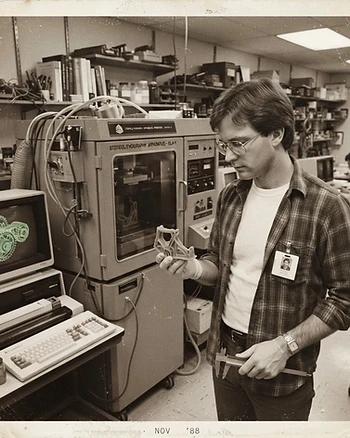
The genesis of this technology traces back to 1986, when American inventor Chuck Hull filed the first patent for stereolithography (SLA). His machine used ultraviolet lasers to cure photosensitive liquid resin into precise, hardened shapes. For decades, these high-fidelity machines were locked away in industrial research facilities, reserved for rapid prototyping in aerospace and medical sectors. The equipment was immense, prohibitively expensive, and required significant technical oversight, keeping the miracle of 'printing' objects out of reach for the general public.
Everything changed in 2009, a pivotal year that saw the expiration of key patents coinciding with the rise of the RepRap (Replicating Rapid Prototyper) project. Founded by Adrian Bowyer, the initiative aimed to create a self-replicating 3D printer that could print its own components. This open-source spirit democratized the technology, inviting makers to share hardware designs and software improvements globally. The barriers to entry crumbled as affordable desktop units like the Prusa i3 transformed the landscape, replacing massive industrial vats with reliable, heated build plates and reliable plastic filament extrusion.
To begin your journey, you need a desktop printer, a spool of thermoplastic filament—typically PLA or PETG—and a 'slicer' program. The slicer serves as your digital technician, converting a 3D model into a set of precise instructions known as G-code. This code dictates the path of the printer’s heated nozzle, the temperature of the extruder, and the velocity of the print head. Once the model is prepared, the printer begins its work, moving in rhythmic patterns that are meditative to watch. The process is a test of patience and physics, demanding an understanding of adhesion, cooling, and structural integrity.
For an empty nester, this hobby serves as the ultimate creative sandbox. It rewards a structured, methodical mindset. You might spend an afternoon calibrating the extruder or fine-tuning the first-layer height to ensure a perfect foundation. It satisfies the desire to repair household items, design custom-fit home organizational tools, or even reconstruct vintage parts for long-neglected restoration projects. The desktop printer essentially functions as a laboratory for the curious mind, providing a tangible output for every digital problem you choose to solve.
Modern machines have grown significantly more user-friendly, offering features like auto-leveling beds and filament run-out sensors that eliminate much of the early trial-and-error. Whether you are printing intricate statues, functional mechanical gears, or custom art pieces for your home, the equipment acts as a conduit for your own vision. It is a quiet, solitary, yet deeply rewarding pastime that invites you to master a new language of materials and motion.
Ultimately, 3D printing is a craft of refinement. It encourages a deeper look at how objects are made and provides a sense of agency in a world of disposable goods. As you grow more comfortable with your slicer settings and material choices, you move from simple replicas to original designs. For those of us seeking a new challenge after the years of parenting have passed, the printer offers a rare satisfaction: the ability to manifest a thought into a permanent, physical existence right on your workbench.
“Three-dimensional printing is not merely assembly; it is the patient translation of code into tangible, functional beauty.”
What to gather
A graded list of gear — from the first honest kit to the tools of a life in the craft. The Novice kit is free; the deeper tiers open with membership.
Novice
The first kit — enough to begin honestly.
From novice to proficient
A thirty-day passage. Each node is a day. The terracotta fill marks the ground you have already covered.
Understand the craft: the extruder, the layer, the print, the slicer. Tour the printer and the filament. Today is orientation; the print begins tomorrow.
YouTubeThe Craft and the Bench
3D Print GeneralReflect on the difference between additive and subtractive manufacturing. How does understanding the layer-by-layer process change your perspective on designing objects?
Saved locally to your device


How the cohort practices today
The pulse is quiet — for now.
Be the first to document your 3D Printing journey with #EmptyNexxter.